
A buried heating oil tank can sit forgotten under a Eugene front yard for forty years. Most Eugene homeowners only discover theirs when a buyer's inspector walks the property, a buyer's lender flags "unknown UST," or the side yard starts smelling like fuel oil. None of those discoveries are easy moments.
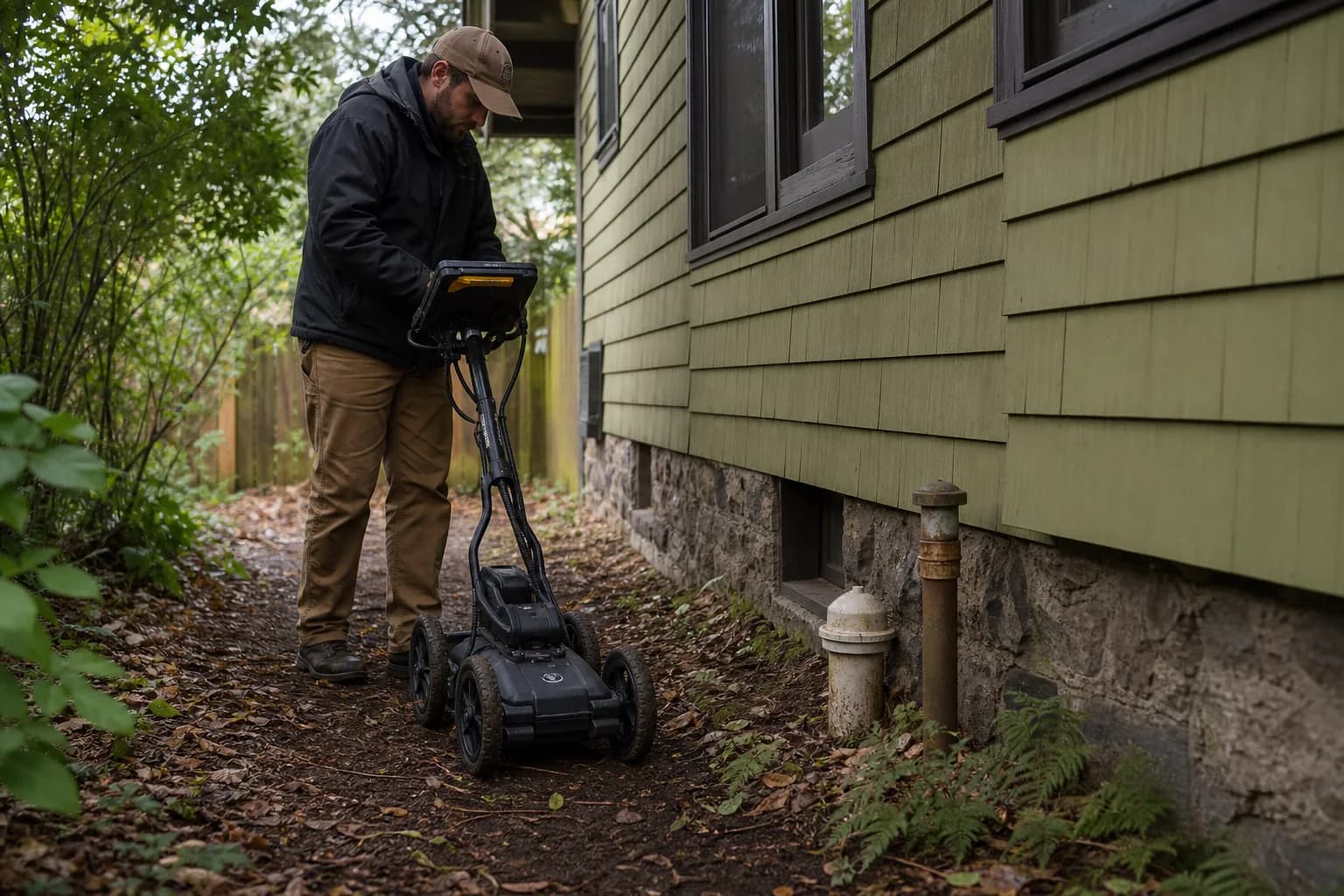
The good news: most tanks leave clues. If you know what to look for and where to look on a typical Eugene lot, you can usually answer "do I have a buried tank" with high confidence in fifteen minutes, no equipment required. For the small minority of properties where visual inspection is inconclusive, a $300 to $500 geophysical scan (ground-penetrating radar or magnetometer) gives a definitive answer.
This guide walks the full discovery process: visual indicators on the property exterior, basement clues that suggest a tank used to feed an oil furnace, and the Eugene neighborhoods where pre-1985 housing stock is most concentrated. For the broader decommissioning context, see the complete Eugene oil tank guide.
In this guide
- 01.Why Eugene homes have buried tanks in the first place
- 02.Eugene neighborhoods most likely to have undiscovered tanks
- 03.Exterior visual clues: what to look for in the yard
- 04.Basement and interior clues: what an oil furnace leaves behind
- 05.When visual inspection is inconclusive: ordering a tank locate
- 06.What to do if you find (or confirm) a tank
- 07.Pre-purchase diligence: what buyers should do
Why Eugene homes have buried tanks in the first place
Before NW Natural's service area expansion reached most of Eugene in the 1980s and 1990s, residential heating was dominated by fuel oil delivered to a buried tank in the front or side yard. Tanks were installed at construction time, refilled twice a year by an oil truck, and lasted 30 to 50 years before steel corrosion began.
Three things to know about the Eugene housing stock:
- 01.Eugene homes built 1940 to 1985 almost certainly had a buried oil tank. A small fraction had basement tanks or aboveground exterior tanks, but the majority were 250 to 500 gallon underground steel tanks in the front or side yard.
- 02.Many tanks were never decommissioned when the homeowner switched to gas. When NW Natural ran service to the neighborhood in the 1980s and 1990s, the conversion typically capped the supply line and abandoned the tank in place without DEQ paperwork (decommissioning rules tightened later).
- 03.The result: an unknown number of "ghost tanks" exist under Eugene yards. They show up at sale time when a buyer's inspector or lender asks. Real-estate transactions are the single most common trigger for late-stage tank discovery.
Eugene neighborhoods most likely to have undiscovered tanks
Tank prevalence correlates almost perfectly with the age of the housing stock. The Eugene neighborhoods most likely to have buried oil tanks are the ones with the highest concentrations of pre-1985 single-family homes:
- 01.Whiteaker. Eugene's most historically intact neighborhood. Heavy pre-1940 stock with later infill. Tank prevalence among original homes is high; many have been decommissioned during prior sales, but undiscovered tanks still surface regularly.
- 02.College Hill. Largely built between 1900 and 1960, with significant pre-1940 stock. Most original homes had buried tanks. Conversion to gas happened in waves through the 1980s and 1990s. Some homes have records of decommissioning; many do not.
- 03.Friendly Area. 1920s through 1960s development. Smaller lots, narrow side yards. Tanks often in narrow side strips between houses, sometimes hard to locate without GPR.
- 04.River Road and Santa Clara. Heavy mid-century (1940-1970) development. Larger lots, tanks usually in the front yard. River Road in particular has a high concentration of homes built in the 1950s-60s with original tanks that were never converted.
- 05.Cal Young. Mostly 1940s-1970s. Mid-century housing with larger setbacks. Tanks typically in the front yard.
- 06.South Hills. Mixed era. The older South Hills properties (1950s and 1960s) frequently have buried tanks; the newer custom homes (post-1985) do not.
- 07.Bethel. Older Bethel housing stock (1940s-60s) is similar to River Road in tank prevalence. Newer Bethel subdivisions (post-1985) generally have no tanks.
- 08.Jefferson Westside. Mixed pre-1960 stock. Tank prevalence varies by block.
Note
Homes built after about 1985 generally do NOT have buried heating oil tanks. By the late 1980s, new construction was wired for NW Natural gas or electric heat. The buried-tank issue is almost entirely a pre-1985 housing stock issue.
Exterior visual clues: what to look for in the yard
Walk the perimeter of your property looking for these indicators. Most tanks were installed within 10 to 20 feet of the house, in the front or side yard, accessible from the driveway or street for refilling trucks.
- 01.Vent pipe. A 1 to 2 inch metal pipe protruding from the ground or from a foundation wall. The classic vent pipe is 6 to 18 inches tall, painted or galvanized, sometimes with a curved cap. This is the single most reliable indicator of a buried tank.
- 02.Fill cap. A 4 inch round metal disc at ground level, often in a flower bed or against a foundation. Sometimes labeled "OIL," sometimes flush with the ground and overgrown. Hardest to see when buried under gravel or new sod.
- 03.Patched section of driveway or sidewalk. When tanks were installed, the truck driver opened the lid through whatever surface was overhead. Driveway patches from the 1960s-80s where the asphalt color does not match are common tank-access points.
- 04.Concrete pad or square inset in the yard. Some tanks had small concrete service pads above them. A 2x2 foot concrete square in a Eugene yard with no obvious purpose is often a tank access point.
- 05.Bare patch where grass does not grow. If the soil above a tank settled slightly or contains fuel oil residue, the grass may not grow as well as the surrounding lawn. Not reliable on its own but a clue when combined with other signs.
- 06.Old "OIL" sticker or label. Look on the side of the house where a fuel supply hose would have connected. Sometimes still visible decades later.
Basement and interior clues: what an oil furnace leaves behind
Even after the oil furnace was removed and a gas furnace took its place, the original oil-heat setup leaves traces inside the house. Walk the basement, crawl space, or utility room looking for:
- 01.Capped supply line stub. A 3/8 to 1/2 inch copper or steel pipe protruding from a foundation wall, capped off, sometimes painted over. The supply line ran from the buried tank, through the foundation, to the oil furnace.
- 02.Capped return line stub. A second pipe near the supply line. Heating oil systems typically had a supply and a return.
- 03.Old oil furnace footprint. A square or rectangular outline on the basement floor where an oil furnace used to sit. Sometimes a poured concrete pad slightly larger than the current furnace.
- 04.Chimney flue size. Oil furnaces vented through larger flues than modern gas furnaces. A double-walled stainless flue retrofit through a much-larger original chimney often indicates a previous oil-heat conversion.
- 05.Old fuel filter on a wall. Sometimes left in place after conversion. Round or cylindrical filter housing about 6 inches in diameter, with brass fittings.
When visual inspection is inconclusive: ordering a tank locate
When visual clues are absent or ambiguous (no vent pipe visible, no basement supply stub, but the house is from the right era), a geophysical tank locate gives a definitive answer.
- 01.Ground-penetrating radar (GPR). Pulls a radar antenna across the yard in a grid pattern. Effective on Eugene's typical clay-loam soils. Identifies the tank as a clear hyperbolic reflection. Service cost $300 to $500 with same-day or 24-hour report.
- 02.Magnetometer survey. Detects ferrous metal (the tank steel) through differences in the local magnetic field. Faster than GPR but less precise about depth and dimensions. Service cost $250 to $400.
- 03.Combined GPR + magnetometer. Some providers offer both, particularly when the property has a lot of buried infrastructure (irrigation lines, electrical service, well casing). $400 to $700.
- 04.DEQ database check. Searching the property address in DEQ's Heating Oil Tank database is free and tells you whether a tank was ever decommissioned with paperwork. If the database shows nothing, either no tank ever existed or a tank existed and was decommissioned without filing (pre-1990s removals).
Tip
Many Eugene-area decommissioning providers include the tank locate free if you sign for the full decommissioning at the same visit. Worth asking. If you are only doing diligence (no decommissioning yet), the locate is a separate $300 to $500 service.
What to do if you find (or confirm) a tank
Discovery is the easy part; what to do next depends on your situation.
- 01.Tank in use, working: no immediate action. Active tanks are legal to operate as long as they pass periodic visual inspection. Most Eugene homeowners with active tanks plan a decommissioning when they convert to gas or sell.
- 02.Tank inactive (gas conversion happened but tank not removed): plan decommissioning. Oregon DEQ requires out-of-service tanks to be decommissioned under OAR 340-177. No immediate enforcement pressure on an inactive tank, but the issue surfaces at the next sale.
- 03.Tank you are about to sell over: decommission before listing. Selling a Eugene property with an undecommissioned tank narrows the buyer pool and forces a price reduction. See the rental/sale guide for transaction timing.
- 04.Tank showing signs of leak (oil smell, ground stains, falling fuel gauge): emergency response. Active leaks require immediate licensed response. Most Eugene-area providers offer same-day emergency callouts. See the cost guide for emergency rate details.
Pre-purchase diligence: what buyers should do
If you are buying a Eugene property and the seller disclosure says "yes, oil tank" or "unknown," your diligence checklist:
- 01.Pull the DEQ database entry. Search the address. A clean Decommissioning Report on file is the best possible outcome.
- 02.Request prior Decommissioning Report if any. Seller or seller's agent should produce a copy of any documentation.
- 03.If "unknown" and pre-1985 home: order a tank locate. $300 to $500 confirms presence or absence.
- 04.If a tank is present and undecommissioned: get a decommissioning quote. So you know the cost before deciding whether to require seller-funded decommissioning or take a credit.
- 05.Walk the property visually with the inspection checklist above. Most inspectors do not specifically check for oil tanks unless asked.
Get a quote
Ready to schedule a Eugene-area decommissioning?
Free site survey, fixed-price written quote, full DEQ closeout documentation filed at the East 7th Avenue office. Most surveys scheduled within 48 hours.
Request a Written QuoteDiscovery: Common Questions
How accurate is the visual inspection method?+
For tanks installed with a visible vent pipe or fill cap, very accurate. For tanks where the vent pipe was removed during a previous conversion and the fill cap has been buried under sod or paved over, materially less so. A pre-1985 Eugene home with no visual indicators in the yard but a basement supply-line stub is still very likely to have (or have had) a buried tank. When in doubt, order a locate.
Can I rent a tank locate device and do it myself?+
In theory yes, in practice no. GPR equipment costs $30,000+ and operators train extensively to read the results. The $300-$500 fee for a professional locate is much cheaper than buying or renting equipment, and the operator interprets the data correctly. Most Eugene-area providers do not even offer DIY-friendly tools because misinterpretation is the norm.
My DEQ database search came back empty. Does that mean no tank?+
Not necessarily. A clean database entry means no tank was decommissioned with DEQ paperwork at this address. Either (1) no tank ever existed, or (2) a tank existed and was removed without DEQ paperwork (pre-1990s, when the rules were less strict). For pre-1985 Eugene homes, option 2 is common. The locate confirms which scenario applies.
What about commercial properties?+
Commercial heating oil tanks in Eugene (small commercial like older mixed-use buildings in Whiteaker or downtown) are regulated similarly to residential under OAR 340-177 in most cases. Larger commercial tanks fall under the separate Underground Storage Tank (UST) rules. For commercial property diligence, consider commissioning a Phase I Environmental Site Assessment which covers tank presence as part of the broader investigation.
How long does the tank locate take?+
Typical site visit: 1 to 3 hours for a single-family lot. Report turnaround: same day for a verbal answer, 1 to 3 business days for a written report. Some providers will tell you the answer at the property before leaving the site.
What if I have already done a Phase I ESA and it said no tank?+
Phase I ESAs use historical research and visual indicators but do not always include a GPR scan. If the Phase I report says no tank but the property is pre-1985 and a buyer's lender still wants confirmation, ordering a separate locate ($300-$500) is faster and cheaper than re-doing the Phase I.
Can a tank locate detect contamination too?+
No. Locates detect the physical tank; they cannot detect soil contamination. Confirmation of contamination requires soil sampling, which only happens during decommissioning. See the main guide for the soil sampling protocol.
Related services and references
Guide
Complete Eugene Oil Tank Removal Guide
What to do once the tank is confirmed.
Guide
Oil Tank Removal Cost in Eugene
Pricing including the locate fee and full decommissioning options.
Guide
Selling a Eugene Rental Property with an Oil Tank
When discovery is driven by a real-estate transaction or rental audit.
Guide
Oil Tank Replacement and Gas Conversion in Eugene
When discovery is the precursor to converting fuel.
Service
Underground Oil Tank Removal
The standard scope once a tank is confirmed.