
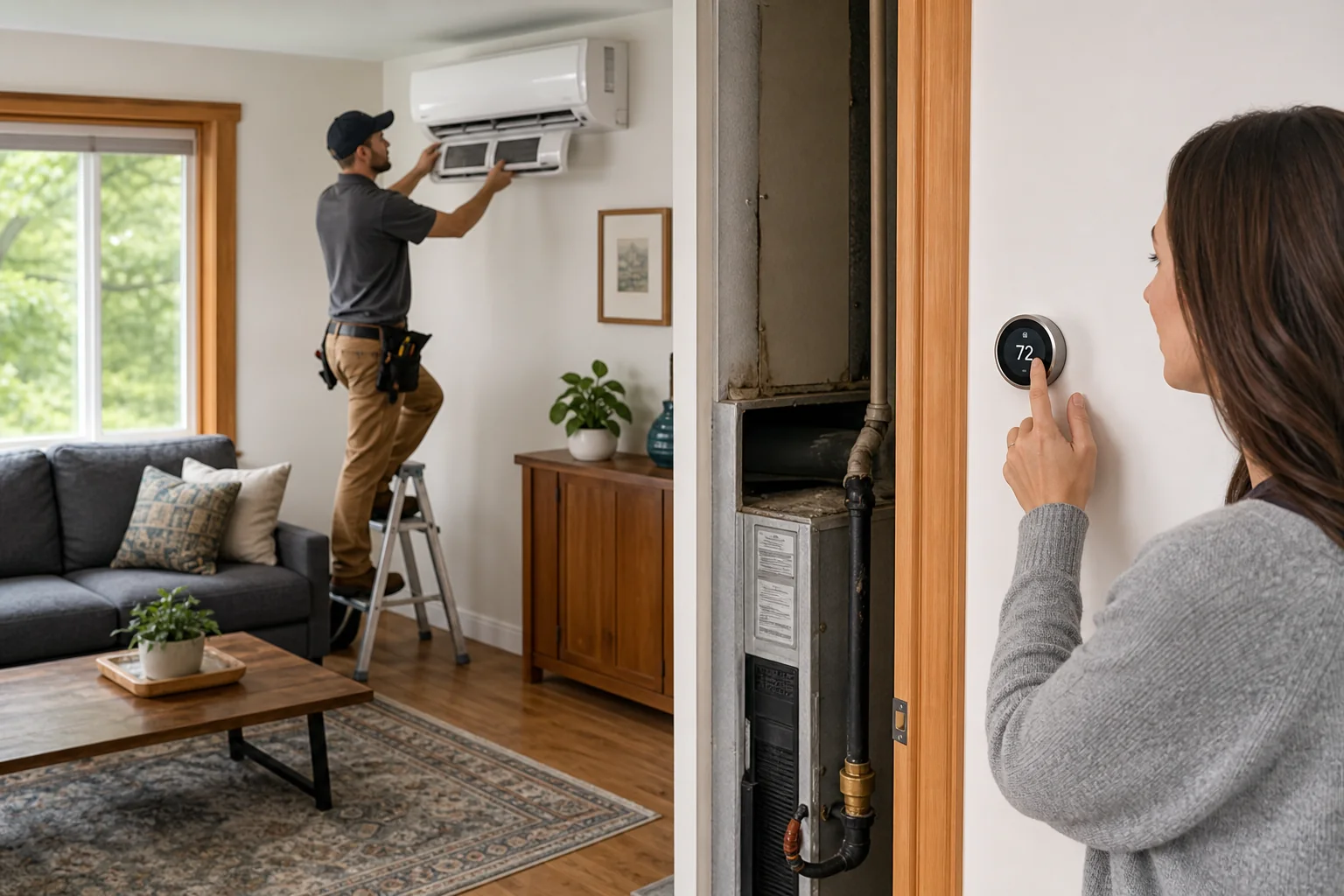
Most homeowners land here for one of two reasons. The tank failed: it is weeping at a seam, the gauge is unreliable, or an insurer flagged it, and you have to decide what replaces it. You are already switching fuel: you picked gas or a heat pump, and the installer told you the oil tank has to be decommissioned before they can finish.
What makes Eugene different from most Oregon oil-tank towns is that the answer is genuinely three-way. This is an EWEB city with a strong electrification push, so a large share of homeowners pulling an old oil tank are not moving to gas at all. They are putting in a heat pump and never burning a fuel on site again. Gas conversion is still common, but here it competes head to head with electrification in a way it does not in a gas-default market.
So this guide is built around the fork rather than around gas. We cover all three exits: a new oil tank if you are staying on oil, an NW Natural conversion, and an EWEB or Springfield Utility Board heat-pump electrification. For the decommissioning mechanics that apply no matter which you choose, see the complete Eugene oil tank guide. For the electrification path in depth, see the Eugene heat-pump conversion guide.
In this guide
- 01.Three paths out of a failing oil tank
- 02.Why Eugene splits between gas and heat pumps
- 03.Path B in detail: converting to NW Natural gas
- 04.Path C in detail: electrifying with a heat pump
- 05.Path A in detail: staying on oil with a new tank
- 06.What each path costs in 2026 Eugene
- 07.The tank work you owe DEQ no matter which path
- 08.Timing it around Eugene winters and UO rentals
Three paths out of a failing oil tank
Before you price anything, decide which heat source you are landing on. Each path carries a different upfront cost, a different rebate picture, and a different long-run bill. The tank decommissioning sits underneath all three and does not change much between them.
- 01.Path A: a new oil tank. You stay on oil heat and swap the failed tank for a fresh aboveground one. Cheapest upfront, no fuel-system change, but you keep paying Eugene oil prices and you will revisit this in 15 to 20 years. Mostly chosen at the rural edge of Lane County where no gas main reaches.
- 02.Path B: NW Natural gas. You drop oil heat and connect to the gas main. Mid-range upfront, predictable on-demand heat, modest conversion rebates. Common across the Eugene-Springfield core where the main already runs down the street.
- 03.Path C: an EWEB or SUB heat pump. You electrify and burn nothing on site. Highest equipment cost before incentives, but Eugene's utility rebates plus the federal credit close much of that gap, and the running cost is the lowest of the three for a well-insulated home. The default choice for a growing share of Eugene owners.
Note
Whichever path you take, the old tank still has to be decommissioned to Oregon DEQ standards and a Decommissioning Report filed. Picking gas or a heat pump does not let you walk away from the tank in the ground; it just changes what gets installed afterward.
Why Eugene splits between gas and heat pumps
In a typical Oregon town a failing oil tank means a gas conversion. In Eugene the decision genuinely forks, and a few local factors are why.
- 01.EWEB is a municipal electric utility with its own incentives. Eugene Water & Electric Board runs heat-pump rebate programs for its residential customers and markets electrification directly. That is a different posture from a town served only by an investor-owned utility.
- 02.Springfield runs on SUB. Properties on the Springfield side draw electricity from Springfield Utility Board, which carries its own heat-pump incentives. Rural pockets fall under Pacific Power. Which electric utility you sit under changes the rebate math, so confirm your meter before you assume a number.
- 03.The climate goals are local and active. Eugene homeowners skew toward carbon-reduction motives more than the regional average, and the mild Willamette Valley winter is well inside the working range of a modern cold-climate heat pump. The equipment fits the climate.
- 04.Gas still wins for some older housing. Drafty pre-war stock with no insulation budget, or a recent high-efficiency oil furnace that is cheaper to feed than to replace, can still pencil out for gas or even a new oil tank. The fork is real in both directions.
The practical takeaway: do not assume gas just because the neighbor did it. Run the heat-pump number with your actual utility before you commit, because the Eugene incentive stack often makes electrification the cheaper ten-year answer.
Path B in detail: converting to NW Natural gas
NW Natural is the gas utility for Eugene-Springfield and most of western Oregon. If the main already runs past your lot, conversion is well-defined. The order of operations matters more than anything else.
- 01.Confirm the main and the cost. NW Natural's address lookup tells you in seconds whether your street is served. Inside the urban growth boundary almost all of it is. A free site visit scopes the run from main to meter; a standard connection lands at $0 to $1,500, and some blocks qualify for a no-cost hookup promotion.
- 02.Decommission the tank first. The crew that sets your meter needs the oil tank handled before they finish. Plan the tank work as the opening move, not an afterthought.
- 03.Run the inside work. Once the meter is live, a licensed plumbing or HVAC contractor pipes gas from the meter to the furnace, adds any drops you want for a range or dryer, pulls the old oil furnace, and sets the new gas unit.
- 04.Close it out. File the tank Decommissioning Report with DEQ, pass the mechanical inspection on the gas work, and NW Natural turns the service on.
Note
NW Natural crews will not set a meter while a live heating-oil tank is still buried on the property, so the realistic order is tank decommissioning, then gas line, then furnace. The tank decommissioning and the NW Natural connection can be scheduled in parallel once both are booked, which is where most of the calendar savings come from.
Path C in detail: electrifying with a heat pump
For a well-sealed Eugene home, a heat pump is frequently the lowest-running-cost option and the one local incentives reward most. The full mechanics live in the dedicated Eugene heat-pump guide; the short version for someone standing over a dead oil tank:
- 01.No gas line, no fuel deliveries, nothing burning on site. The oil furnace comes out, a ducted or ductless heat pump goes in, and the property runs entirely on electricity.
- 02.EWEB or SUB rebates plus the federal credit. Depending on whether your meter is EWEB, Springfield Utility Board, or Pacific Power, utility rebates stack with the federal 25C credit on qualifying equipment. The combined incentive is usually larger than what gas conversion offers.
- 03.Panel and ductwork checks. Older Eugene homes sometimes need an electric panel upgrade to carry the new load, and pre-1965 wiring is the most common surprise cost. A load calc up front catches it.
- 04.The tank still goes. Electrifying does not exempt the buried tank. It is decommissioned exactly as it would be for a gas conversion.
Tip
Get the heat-pump quote and the gas-conversion quote side by side before you decide. In Eugene the incentive-adjusted ten-year cost is often where the heat pump wins, even when its sticker price is higher, so comparing only the install-day numbers can point you the wrong way.
Path A in detail: staying on oil with a new tank
A minority of Eugene-area owners replace a failed oil tank with a new oil tank rather than changing fuel. It is almost always a geography or timing call:
- 01.No gas main and a long electric run. Out past the urban growth boundary, along the McKenzie River corridor, around Coburg, Veneta, or rural Springfield, neither the gas main nor an easy panel upgrade is close. A new aboveground oil tank is the path of least resistance.
- 02.A young, efficient oil furnace. If the furnace itself is recent, replacing only the tank protects that investment. Scope is narrow: decommission the old tank, set a new aboveground steel or fiberglass tank, transfer the supply line.
- 03.A deliberate backup-heat setup. A few owners keep oil as a redundant system and accept the running cost for the resilience.
A 275-gallon aboveground replacement runs about $1,800 to $3,500 installed, on top of the decommissioning cost for the old tank. New buried residential heating-oil tanks are effectively off the table; Oregon jurisdictions no longer permit them, so any replacement goes aboveground.
Watch out
It is worth pricing the other two paths before you default to a new oil tank. A fresh tank is the cheapest day-one option, but it carries no conversion or electrification rebates and locks in oil prices for another two decades, so its ten-year cost often loses to gas or a heat pump even after the higher install bill.
What each path costs in 2026 Eugene
Rough all-in ranges for the Eugene-Springfield market, before incentives. The tank decommissioning line is shared across all three.
- 01.Shared: oil tank decommissioning, $1,400 to $3,500. Removal or abandonment in place plus soil sampling. Full cost breakdown.
- 02.Path A, new oil tank: add $1,800 to $3,500. Aboveground 275-gallon tank and supply-line transfer. No rebates apply.
- 03.Path B, gas conversion: add $5,000 to $12,500. NW Natural connection ($0 to $1,500), inside gas piping ($900 to $2,500), and a 95% AFUE gas furnace ($3,800 to $7,800). Conversion and furnace rebates of roughly $800 to $2,500 come back off the top.
- 04.Path C, heat pump: add $6,000 to $16,000. Equipment and install, plus any panel upgrade. EWEB or SUB rebates plus the federal 25C credit typically return $1,500 to $4,500, which closes much of the gap to gas.
After incentives, gas and heat pump land closer together than the sticker prices suggest, and the heat pump usually has the lower running cost from there. The new-oil-tank path is cheapest on install day and most expensive over the life of the system.
The tank work you owe DEQ no matter which path
Whatever heat source you choose, the buried tank is decommissioned the same way, and you choose between two methods:
- 01.Full removal, about $1,800 to $3,500 in Eugene. Excavate, lift, and dispose of the tank. The cleanest record for a future sale, best where the yard is open and restoration is cheap.
- 02.Abandonment in place, about $1,400 to $2,800. Pump, clean, fill, and leave the shell. The call when the tank sits under a driveway, an addition, or mature landscaping you would rather not disturb.
- 03.Sampling is not optional either way. Soil samples are pulled on both methods; abandonment is not a shortcut around testing.
Note
When the tank is being retired as part of a fuel switch rather than because it failed, more owners choose abandonment, since digging out a tank that is already out of service is harder to justify. Abandonment is noticeably more common on fuel-switch jobs than on stand-alone tank jobs for that reason.
Timing it around Eugene winters and UO rentals
The classic mistake is starting too late in the year and ending up stranded between two heat sources in January. A second Eugene-specific wrinkle is the university rental calendar.
- 01.Best window, April through August. Heat is not needed during the swap, utility and HVAC schedules are open, and permit desks are not backed up.
- 02.Workable, September into October. Doable with tight coordination; aim to be finished by mid-October before the cold sets in.
- 03.Avoid November through March if you can. Cold-weather scheduling slips stack on each other, and a one-week delay becomes a one-week stretch with no heat.
- 04.UO rentals: work the lease gap. Around the University of Oregon, the cleanest time to schedule is the summer turnover between tenancies, when the unit is empty and you are not coordinating around a sitting tenant.
Tip
If the calendar forces a winter switch, leave the oil furnace operable until the new system is running and signed off, and carry just enough fuel to cover a scheduling slip. The tank decommissioning itself can trail the heat changeover by a month or two if it has to, so it never needs to be the thing that leaves you cold.
Get a quote
Ready to schedule a Eugene-area decommissioning?
Free site survey, fixed-price written quote, full DEQ closeout documentation filed at the East 7th Avenue office. Most surveys scheduled within 48 hours.
Request a Written QuoteMore Eugene guides on this topic
Heating Oil to Heat Pump Conversion in Eugene: 2026 Homeowner Guide
Replacing a Eugene oil furnace with a heat pump in 2026: EWEB municipal utility incentives layered on Energy Trust of Oregon rebates, IRA 25C federal credit, ductless mini-split path for West University craftsman homes, UO rental considerations.
Signs a Eugene Oil Tank Needs Replacing (2026)
The signs a heating oil tank is reaching the end of its life, age, corrosion, repeated repairs, an insurer notice, and what your replacement options are in Eugene.
Replace, Convert or Electrify: Common Questions
In Eugene, is a heat pump or gas the better replacement for oil heat?+
It depends on your home and your electric utility, which is exactly why you should price both. For a reasonably insulated Eugene home on EWEB or Springfield Utility Board, the heat pump usually wins on ten-year cost once the utility rebate and the federal 25C credit are counted, even though its install price is higher. Gas tends to win for drafty, uninsulated older stock or where a recent oil furnace is worth preserving. Get both quotes side by side before deciding.
Does the buried tank still have to come out if I go with a heat pump?+
Yes. Electrifying does not change the tank obligation at all. The old heating-oil tank is decommissioned to DEQ standards, with soil sampling and a filed Decommissioning Report, exactly as it would be for a gas conversion. The only thing that changes is what gets installed for heat afterward.
Which utility handles my heat-pump rebate in Eugene?+
Whichever electric utility your meter sits under. Most of Eugene proper is EWEB. The Springfield side is Springfield Utility Board. Some rural Lane County pockets are Pacific Power. Each runs its own residential heat-pump incentives, so confirm your meter before you assume a rebate figure. All three stack with the federal 25C tax credit.
How long does NW Natural take to connect service in Eugene?+
Four to twelve weeks for the connection itself. Inside the established Eugene-Springfield service area, four to six weeks is typical; peak fall demand stretches it to eight to twelve. Because the connection runs in parallel with the tank decommissioning and the inside gas piping, the total project length is set by the longest single item, usually the utility connection.
I am at the rural edge of Lane County with no gas main. What are my options?+
Out past the urban growth boundary, along the McKenzie corridor, or around Coburg and Veneta, gas is often not available and an electric panel upgrade can be a long run. That narrows it to a heat pump if the panel supports it, or a new aboveground oil tank if it does not. Both still require the old tank to be decommissioned first.
My buyer wants the fuel switched as a closing condition. Is that realistic in escrow?+
A full gas conversion or heat-pump install does not fit a typical two-to-four-week escrow. The realistic moves are to decommission the tank inside escrow as the closing condition and finish the heat changeover after close, or to negotiate a closing extension. Most Eugene buyers take the first option with a credit toward the new system. See the Eugene sale and rental guide for the contingency language.
What happens to the oil left in the tank?+
The licensed provider pumps residual fuel to a vacuum truck during decommissioning. Small amounts are usually recycled at no charge; larger quantities can carry a per-gallon hauling fee. If the tank is more than half full, some Eugene providers will let you burn it down through the cold months on the existing oil furnace before they schedule the work.
Can I keep the old oil tank as a backup?+
Only if it stays in active use. Oregon DEQ does not allow a tank to sit idle indefinitely; once it is out of service past twelve months, OAR 340-177 requires decommissioning. If you want backup heat, electric resistance, a heat-pump system with electric strips, or a propane tank are the cleaner routes, since propane is regulated separately and can sit longer.
Related services and references
Guide
Complete Eugene Oil Tank Removal Guide
The decommissioning process that every replacement path relies on.
Guide
Heating Oil to Heat Pump in Eugene
Path C in full: EWEB and SUB incentives, panel checks, equipment.
Guide
Oil Tank Removal Cost in Eugene
The shared decommissioning line, broken out by component.
Guide
Selling a Eugene Rental Property with an Oil Tank
When the fuel switch is driven by a rental sale or UO turnover.
Service
Oil Tank Abandonment in Place
The common method when a tank is retired during a fuel switch.
Service
Underground Oil Tank Removal
Full removal when access is open and a clean record matters.