
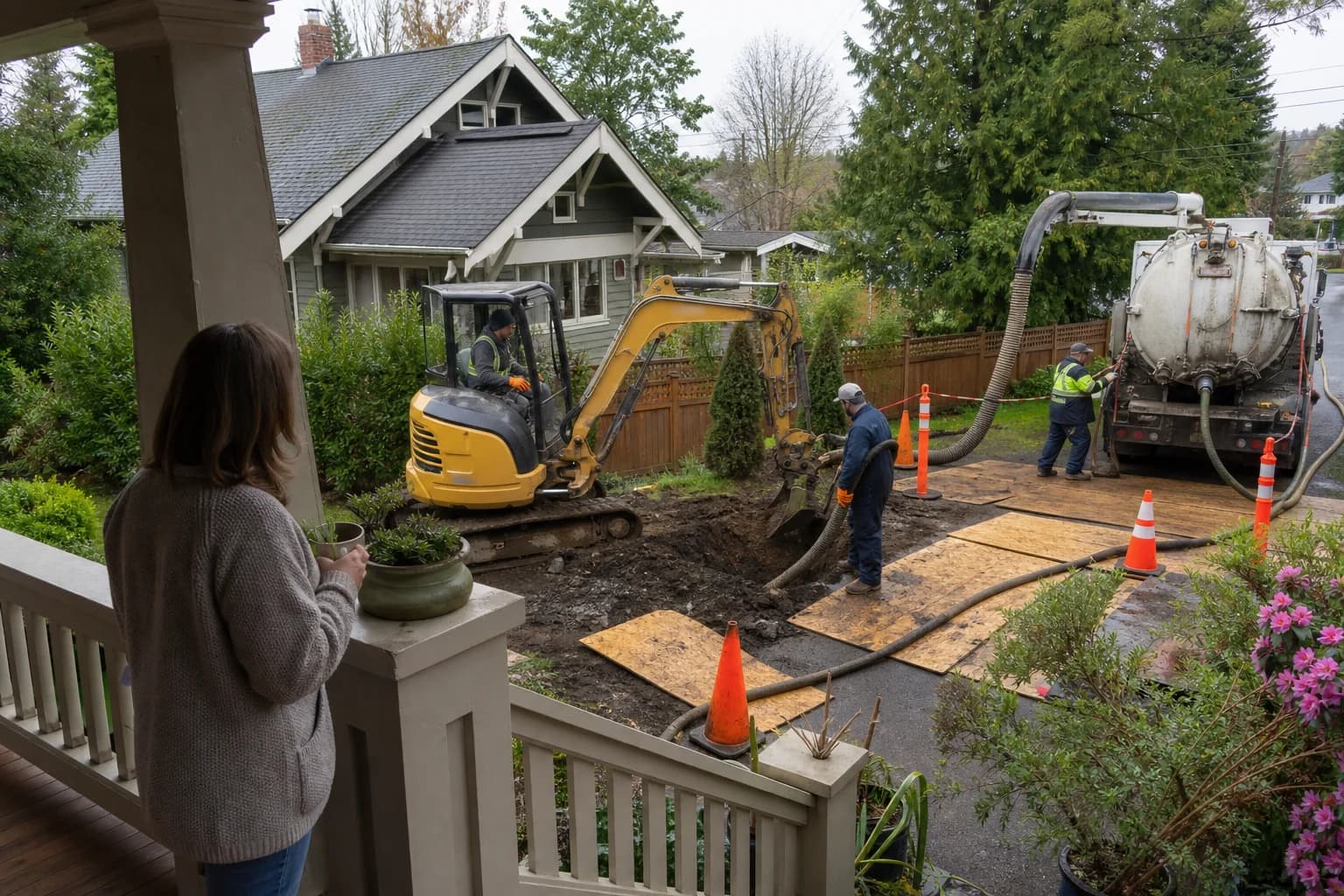
If a buyer's lender just flagged "unknown UST" in your Eugene property file, or a heating oil tank in your front yard just failed, or you are converting to NW Natural gas and the conversion contractor told you the tank has to go: this guide walks through every decision in front of you.
A standard Eugene-area underground heating oil tank decommissioning runs $1,800 to $3,500 when soil samples come back clean, and can climb to $8,000 to $30,000+ when sampling reveals a release and Oregon DEQ requires cleanup. The work is regulated under the Oregon DEQ Heating Oil Tank (HOT) Program (OAR 340-177), must be performed by a DEQ-licensed service provider, and ends with a Decommissioning Report filed at the DEQ Western Region office on East 7th Avenue in Eugene.
This guide covers the full picture: when removal is required, what the work involves, what it costs, and the documentation you walk away with. Deeper dives on individual topics like detailed cost ranges, tank discovery in older Eugene neighborhoods, selling rental properties, and gas conversion sit on their own pages.
In this guide
- 01.When Eugene homeowners deal with an oil tank
- 02.The three tank types you will find in Eugene
- 03.The Oregon DEQ Heating Oil Tank Program in plain English
- 04.The decommissioning process: what actually happens on site
- 05.Soil testing: what gets sampled, what happens if a release shows up
- 06.What it costs in Eugene in 2026
- 07.Eugene-area permit pathways: three jurisdictions
- 08.Removal vs abandonment in place: when Oregon allows each
- 09.Real estate, rentals, and gas conversions
- 10.Choosing a DEQ-licensed service provider in Eugene
When Eugene homeowners deal with an oil tank
Nearly every Eugene-area decommissioning traces back to one of four situations. Pinning down which one is yours tells you how hard the clock is ticking and which paperwork you will be asked to produce.
- 01.Real-estate transaction. A buyer's lender or home inspector flags the presence (or suspected presence) of a buried heating oil tank, and the closing cannot proceed until the tank is decommissioned and a DEQ Decommissioning Report is on file. The most common trigger in Eugene. Escrow drives the schedule here, typically a 14 to 30 day window.
- 02.Conversion to natural gas. You signed a deal with NW Natural to bring a gas line to the property, and the conversion contractor wants the heating oil tank decommissioned before they finish the inside gas piping. Sometimes the tank stays in the ground (abandonment in place); sometimes it comes out (removal). The choice usually comes down to access.
- 03.Active or suspected leak. You smell oil in the basement, see a stain in the soil where the tank sits, the fuel gauge keeps falling without a delivery, or a neighbor's well test came back with TPH. This becomes a release investigation, not a routine decommissioning.
- 04.Insurance audit, rental portfolio review, or owner choice. Your insurer notified you that they will not renew with an active heating oil tank on the property, an audit on a rental property flagged the issue, or you simply want to be done with the liability. No external pressure on timeline, which usually means more flexibility on scheduling and pricing.
Note
With a sale in escrow, the closing date is the deadline and everything else works backward from it. A typical Eugene decommissioning is 1 to 2 working days on site, then another 2 to 6 weeks for lab results and for the Decommissioning Report to be written and filed at the DEQ Western Region office on East 7th Avenue.
The three tank types you will find in Eugene
Heating oil tanks in the Eugene-Springfield metro fall into three categories. Which one you have determines the entire process: the permit pathway, the equipment, the cost, and the documentation.
- 01.Underground storage tanks (USTs). Buried out in the front or side yard, generally 250 to 500 gallons and almost always single-wall 12-gauge steel dropped in between 1945 and 1985. These are the tanks the Oregon DEQ HOT Program was written for, and the ones a Decommissioning Report is mandatory on. See our service page for underground oil tank removal for the workflow.
- 02.Aboveground storage tanks (ASTs) outside. Sitting on legs or a concrete pad against the side of the house, typically 275-gallon oval. Easier to handle (no excavation), but DEQ still requires proper residual product disposal and steel recycling documentation. See aboveground tank removal.
- 03.Basement or crawl-space tanks. Usually 275-gallon oval, installed indoors when the house was built. Decommissioning is constrained by interior access; the tank often gets cut into pieces in place. Not technically a UST under OAR 340-177, but most lenders still want documentation of professional removal.
Tip
Not sure if you even have a buried tank? Eugene homes built before about 1985 frequently had oil tanks installed and then forgotten about after a gas conversion. Tell-tale signs are a vent pipe or fill cap poking up out of a flower bed, a mismatched patch in the driveway, or a capped stub on a basement wall where a supply line once ran. If you cannot find one but a buyer's lender is asking, a tank locate (a $300-$500 scan with ground-penetrating radar or magnetometer) confirms presence one way or the other. See the discovery guide for the full clue list.
The Oregon DEQ Heating Oil Tank Program in plain English
Oregon regulates residential heating oil tank decommissioning under OAR 340-177, administered by the Department of Environmental Quality. The Western Region office in Eugene (165 East 7th Avenue) handles Lane County. The rules run tighter than most homeowners expect, driven by Oregon's groundwater-protection priorities and the shallow water table sitting under the Willamette Valley floor.
What the program requires:
- 01.DEQ-licensed service provider only. Hiring a friend with an excavator is illegal under OAR 340-177 and will not produce the Decommissioning Report that closes the file with DEQ.
- 02.Soil samples at decommissioning. Two to four samples from the tank pit, sent to an ORELAP-accredited lab, tested for TPH-Dx (total petroleum hydrocarbons, diesel range) and BTEX (benzene, toluene, ethylbenzene, xylenes).
- 03.Decommissioning Report submitted for registration. The licensed service provider compiles soil results, photos, tank dimensions, and disposal manifests, then submits the certification to DEQ, which issues a letter registering it. The homeowner gets a copy.
- 04.Confirmed releases trigger the Heating Oil Cleanup Rule (OAR 340-122). If samples exceed DEQ residential cleanup levels, additional excavation, soil disposal, and a separate Cleanup Report are required before DEQ issues a No Further Action determination.
Watch out
The most common Eugene mistake: hiring a generic excavator at a lower price than licensed quotes. Unlicensed work is unrecognized by DEQ. That means no Decommissioning Report, no DEQ database entry, no buyer's lender approval. Check the contractor's DEQ license number against the state list before you sign anything. See the cost guide for why the licensed price is what it is.
The decommissioning process: what actually happens on site
A standard Eugene-area underground tank decommissioning is a 1 to 2 day on-site job. The work is straightforward when soil is clean; the timeline stretches when lab work reveals a release.
- 01.Day 0: site survey and permit. A licensed provider walks the property, locates the tank, files an 811 utility locate, and pulls the permit from City of Eugene Building Permit Services, Springfield Building Department, or Lane County. Typical turnaround 3 to 10 business days.
- 02.Day 1 morning: pump and clean. Crew exposes the tank top, pumps residual fuel and sludge to a vacuum truck for off-site recycling. The tank is cleaned to ASTM standards and verified vapor-free.
- 03.Day 1 afternoon: cut and lift. Tank steel is cut with a non-sparking saw and lifted out of the pit. Crew documents condition (pitting, prior patches, manufacturer) and stages steel for the certified recycler.
- 04.Day 1 or 2: soil sampling. Two to four samples per DEQ guidance: one beneath each end of the tank footprint, sometimes one at the base, and one stockpile sample. Chain of custody signed; samples ship same-day to an ORELAP-accredited lab.
- 05.Day 1 or 2: backfill. If visual inspection shows no obvious contamination, the pit is backfilled with clean fill and compacted in lifts. Site restored: sod, gravel, or whatever surface was originally there.
- 06.Days 7 to 21: lab turnaround. ORELAP lab returns TPH-Dx and BTEX results. If all below DEQ cleanup levels, the file proceeds to closure. If any result exceeds, a release determination is made.
- 07.Report filing. Once the lab results are in, the provider compiles the Decommissioning Report and submits it to the DEQ Western Region office in Eugene. Timing depends on lab turnaround and the provider's drafting queue, so it varies. Homeowner receives a copy for the property file.
Soil testing: what gets sampled, what happens if a release shows up
Soil testing is where a routine decommissioning can tip into an expensive cleanup. A minority of Eugene-area underground tank jobs turn up some level of release. Most of those are minor and close out with a bit of extra digging; only a handful escalate into full DEQ Cleanup Rule cases.
Samples go to ORELAP-accredited labs for two primary analyses:
- 01.TPH-Dx (total petroleum hydrocarbons, diesel range C10 to C24). Primary screening test for heating oil. Results at or above 50 mg/kg by NWTPH-Dx define a below-ground release, and the level you clean to afterwards is set by DEQ's soil matrix at 100, 500, or 1,000 ppm.
- 02.BTEX (benzene, toluene, ethylbenzene, xylenes). Benzene is the tightest constraint in the panel. Under DEQ's generic remedy it cannot exceed 0.1 ppm for a site to qualify for that cheaper route.
- 03.PAH (polycyclic aromatic hydrocarbons), when warranted. Required when older heating oil or weathered contamination is suspected.
If samples come back clean, which is the usual outcome, the Decommissioning Report files and the case closes. If samples exceed cleanup levels, the case becomes a release investigation: additional sampling to characterize extent, excavation of contaminated soil, off-site disposal, confirmation samples to verify cleanup, supplemental Cleanup Report, and ultimately a DEQ No Further Action determination.
Oregon has no reimbursement fund, insurance pool, or grant program for residential heating oil cleanup. The cost falls on the property owner, and DEQ is explicit that the current owner of the property is responsible for any necessary cleanup even if the leak happened before he or she bought the property. What the owner can influence is which closure pathway the site qualifies for, and that is decided by the sampling data.
Note
If contamination is confirmed, do not panic. DEQ publishes a generic remedy for qualifying residential heating oil sites that eliminates the need for site-specific risk characterization, which is the cheaper of the two closure routes. Most cases that qualify close with a No Further Action letter that follows the property in DEQ's database. See our soil testing and cleanup service page for the technical workflow.
What it costs in Eugene in 2026
Here are the 2026 ranges. These reflect actual quotes from DEQ-licensed providers working inside the 97401-97408 corridor; rates further out in Lane County run different.
- 01.Underground tank, clean decommissioning, full removal: typically $1,500 to $3,500. Most common Eugene scenario. Includes permit, locate, excavation, pump and clean, cut and remove, 2-3 soil samples, backfill, ORELAP lab fees, Decommissioning Report.
- 02.Underground tank, clean abandonment in place: typically $1,200 to $2,800. Tank stays in the ground after pump/clean/fill. Used when removal would damage permanent structures.
- 03.Aboveground tank, exterior: typically $400 to $1,600. Disconnect, pump, cut, recycle. No excavation but DEQ still requires residual product manifest.
- 04.Basement or crawl-space tank: typically $1,000 to $2,000. Pump, clean, cut in place, remove through doorways or stairwells.
- 05.Localized contamination cleanup adder: typically $3,500 to $15,000. Additional excavation, off-site soil disposal, confirmation samples, supplemental report.
- 06.Full DEQ Cleanup Rule case: typically $15,000 to $75,000 and up. Site characterization, possible monitoring wells, Cleanup Report, DEQ No Further Action letter. This is the risk-based route, used when the site cannot meet the generic remedy conditions.
Tip
What your soil samples come back as is the one variable that really moves the bill. Every other factor swings it by hundreds of dollars; a confirmed release swings it by tens of thousands. See the full Eugene pricing guide for the line-by-line breakdown and what cheaper quotes typically leave out.
Eugene-area permit pathways: three jurisdictions
Eugene-area tank decommissionings cross three permit jurisdictions depending on the property address. Knowing which one applies tells you the fee, the turnaround, and where the inspector comes from.
- 01.City of Eugene (97401, 97402, 97403, 97404, 97405, 97408). Building Permit Services on Pearl Street. Fee typically $150 to $300. Turnaround 3 to 7 business days. Inspector visits at backfill.
- 02.Springfield (97477, 97478). Springfield Building Department. Similar fee structure. Turnaround often slightly faster than Eugene.
- 03.Lane County (unincorporated). County Land Management Division. Different fee structure based on parcel. Turnaround 5 to 10 business days.
The licensed service provider pulls the permit. The homeowner is the permit-holder of record but does not interact with the permit office directly. The provider also books the 811 utility locate before excavation begins.
Removal vs abandonment in place: when Oregon allows each
Oregon DEQ allows two routes for decommissioning an underground tank: removal (excavate and lift out) and abandonment in place (pump, clean, fill with sand or controlled low-strength material, leave in ground). Either route ends in a Decommissioning Report. Which one you use is dictated by site conditions, not by preference.
- 01.Removal is the default. Excavation gives the cleanest closeout: full tank inspection for pitting, direct visual of the soil beneath the tank, full soil-sample coverage. Most Eugene-area decommissionings go this route.
- 02.Abandonment in place is allowed when removal would damage structures. Tank under a concrete driveway extension, under a load-bearing addition, under a mature street tree the City of Eugene would not permit removed, or within clearance distance of a foundation footing. The licensed provider documents the structural justification.
- 03.Abandonment still requires the same soil sampling. One important misconception: abandonment is NOT a way to skip the soil testing. DEQ requires the same TPH-Dx and BTEX panel, sampled through bore holes rather than open excavation.
- 04.Abandonment is slightly cheaper but produces a less clean property record. The DEQ database flags abandonment-in-place tanks. Future buyers see the notation and may ask for additional evaluation. The savings ($300 to $700 typically) often disappear at the next sale.
Tip
Default to removal when you can. Abandonment in place earns its place only when pulling the tank is genuinely impractical. See the abandonment in place service page for the technical workflow.
Real estate, rentals, and gas conversions
In Eugene's 2026 market, three drivers account for most oil tank decommissionings: real-estate sales (the closing-condition pressure), rental property compliance (Eugene's heavy rental market drives portfolio-wide audits), and NW Natural gas conversions (rebate-driven decisions to switch fuels).
- 01.Real-estate sale. Oregon law (ORS 105.464) requires sellers to disclose known oil tanks. Most Eugene-area lenders require decommissioning before closing. See the selling a Eugene property guide for transactional timelines.
- 02.Rental portfolio compliance. Eugene is ~50% renters (highest in Oregon due to UO). Landlord-tenant law and insurance underwriting both push for active tanks to be decommissioned or documented. Many Eugene landlords run rolling decommissionings across a portfolio every 2-3 years.
- 03.NW Natural conversion. Rebates from NW Natural and Energy Trust of Oregon can offset part of the conversion cost, and the amounts change year to year, so check the current program terms before budgeting. The conversion sequence requires the oil tank to be decommissioned before NW Natural will connect service. See the conversion guide for the full workflow.
Choosing a DEQ-licensed service provider in Eugene
Oregon requires heating oil tank work to be performed by a DEQ-licensed Heating Oil Tank Service Provider. DEQ publishes the current licensed-provider list, and a subset of those providers work the Eugene-Springfield market regularly. Things to verify before signing a quote:
- 01.DEQ license number on the proposal. Verify it against the DEQ Service Provider list. Active license, in good standing.
- 02.General liability insurance and workers comp. $1M general liability minimum; pollution-liability coverage matters if a release is suspected.
- 03.Fixed-price quote, not "starting from." A licensed Eugene-area provider knows what typical jobs cost. Open-ended quotes with "additional fees may apply" almost always end higher.
- 04.Written soil-sample plan. Quote should specify number of samples, locations, lab name (ORELAP-accredited only), analyte panel, turnaround time.
- 05.Decommissioning Report turnaround. Ask the provider to commit to a filing window in writing. The real driver is lab turnaround and the provider's own drafting queue, so a quote that leaves the date open should be questioned.
- 06.Local Eugene-area references. Work from the last 12 months, ideally same kind of tank you have. Pre-1985 buried single-wall steel needs specific experience.
Get a quote
Ready to schedule a Eugene-area decommissioning?
Free site survey, fixed-price written quote, full DEQ closeout documentation filed at the East 7th Avenue office. Most surveys scheduled within 48 hours.
Request a Written QuoteMore Eugene guides on this topic
Complete Guide: Common Questions
Do I really need to remove the tank, or can I just leave it?+
You cannot legally leave a heating oil tank in the ground "active" once it stops being used for its intended purpose. Oregon DEQ requires decommissioning of any out-of-service heating oil tank under OAR 340-177, either by removal or by abandonment in place. Your options are removal or abandonment in place, not removal or nothing.
How long does the whole process take from quote to filed Decommissioning Report?+
On a clean tank, plan on 5 to 8 weeks end to end: roughly 1 to 2 weeks for the permit, 1 to 2 days on site, 2 to 3 weeks for ORELAP lab turnaround, and 1 to 3 weeks for the Decommissioning Report to be drafted and filed at the DEQ Eugene office. A confirmed release tacks another 1 to 6 months onto that for the cleanup phase.
Where is the DEQ Western Region office that handles Eugene?+
The DEQ Western Region office that processes Lane County Decommissioning Reports is at 165 East 7th Avenue in Eugene, between Pearl and Oak. The licensed service provider files reports directly with this office. The homeowner does not need to interact with DEQ directly under normal circumstances.
My quote is much cheaper than the licensed quotes. Can I just use that?+
No, and the math does not work out. Unlicensed work does not produce a Decommissioning Report, the property does not appear in DEQ's database as closed, and the work will not satisfy any buyer's lender or title company at closing. The hidden cost (re-doing the work under license, plus potential DEQ enforcement) far exceeds the apparent savings. See the cost guide for what licensing actually buys you.
What if I am converting to NW Natural gas?+
The oil tank decommissioning is always the first step of the conversion. NW Natural will not connect service to a property with an active heating oil tank. After decommissioning, NW Natural runs the meter, an HVAC contractor installs the gas furnace, and the inside gas piping connects everything. Total conversion timeline is 6 to 12 weeks. See our conversion guide for the full sequence.
I own a Eugene rental property with a tank. What are my obligations?+
As an Oregon landlord, you have disclosure obligations under ORS 90.305 (rental property disclosure), and your insurer almost certainly excludes oil tank liability from your landlord policy. Most Eugene-area rental portfolios are decommissioning tanks rolling across the portfolio rather than waiting for the issue to surface at sale. See the rental property guide for landlord-specific considerations.
How do I know if my Eugene property has a buried tank?+
Look for a vent pipe or fill cap standing up in the yard, a patched-over strip of driveway, or capped supply-line stubs on a foundation wall. Eugene's older neighborhoods (Whiteaker, College Hill, Friendly Area, River Road, Santa Clara) have the highest pre-1985 housing stock concentration and the most undiscovered tanks. See the discovery guide for the full checklist.
Are there grants or financial assistance for tank cleanup?+
No. Oregon has no reimbursement fund, insurance pool, or grant program for residential heating oil cleanup, and DEQ states that the current owner of the property is responsible for any necessary cleanup even if the leak happened before he or she bought the property. The realistic way to hold the cost down is to qualify for DEQ's generic remedy, which eliminates the need for site-specific risk characterization on qualifying sites. Sites that cannot meet its conditions go the risk-based route instead, which is legitimate closure but costs more.
Related services and references
Guide
Oil Tank Removal Cost in Eugene
Detailed 2026 pricing breakdown by scenario and tank type.
Guide
Find a Buried Oil Tank in Eugene
Discovery guide for Whiteaker, College Hill, Friendly Area, River Road, and Santa Clara.
Guide
Selling a Eugene Rental Property with an Oil Tank
Landlord obligations, tenant disclosure, portfolio compliance, transaction timing.
Guide
Oil Tank Replacement and Gas Conversion in Eugene
Step-by-step when converting to NW Natural gas, with Energy Trust rebate detail.
Service
Underground Oil Tank Removal
Full UST decommissioning with DEQ filing.
Service
Soil Testing & Contamination Cleanup
TPH-Dx and BTEX sampling, DEQ Cleanup Rule cases, generic remedy closure.