
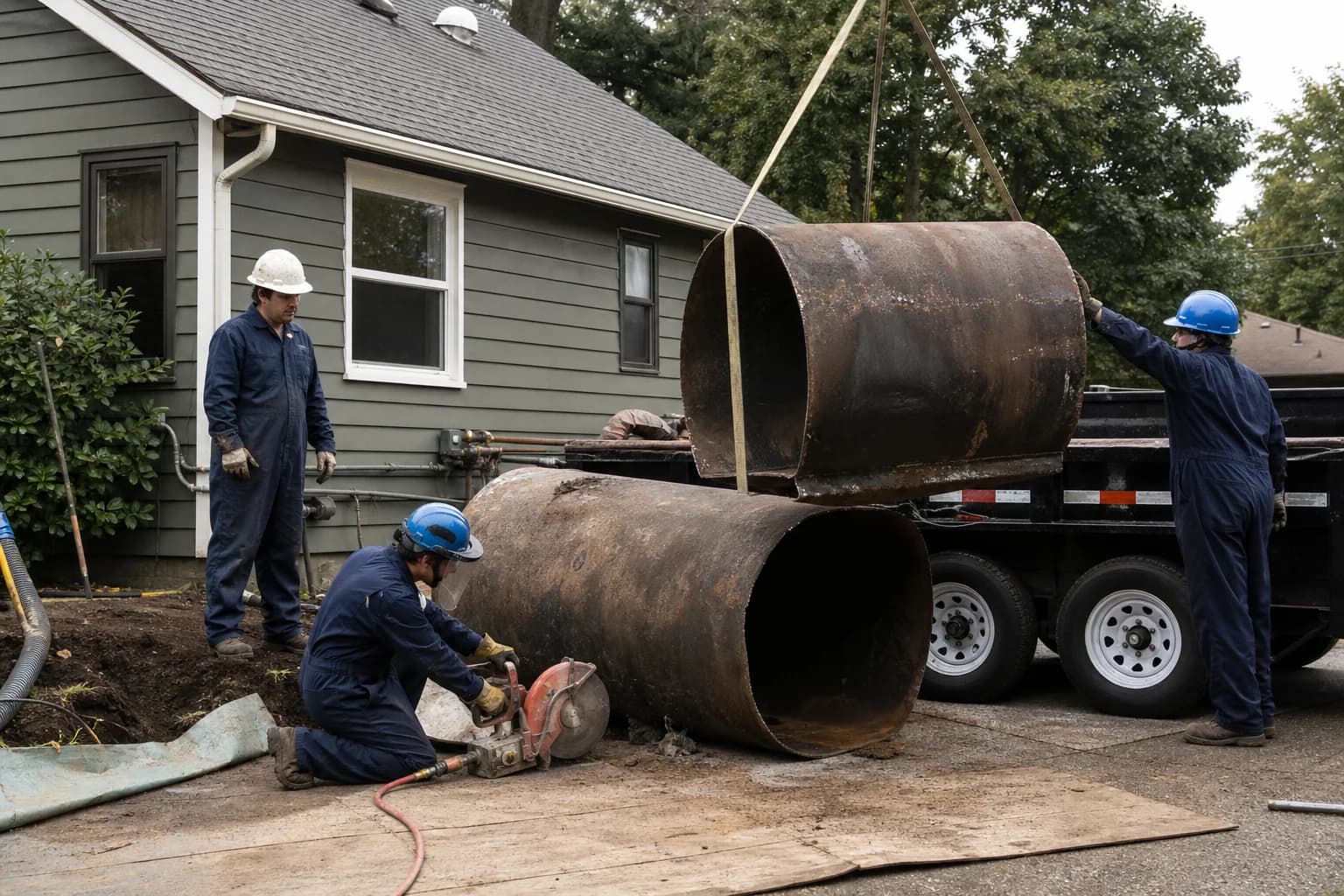
Oil tank removal day in Eugene is shorter and calmer than most homeowners expect. On a routine buried tank with clean soil, a licensed crew arrives in the morning, marks and protects the work area, pumps and cleans the tank, cuts and lifts it out, pulls soil samples from the pit floor, backfills the hole, and passes an inspection, usually inside a single working day. Here is how that day actually unfolds so nothing catches you off guard.
Before the crew arrives: locate and access
By the time the excavator shows up, two things are already handled. The local permit that authorizes the dig has issued, so the dig is authorized, and a utility locate has been requested through Oregon 811, which marks gas, water, power, and telecom in the work area at least a couple of business days ahead and free of charge. Those colored paint lines and little flags you see in the yard are not decoration; they keep a bucket away from a live gas service.
The crew starts by confirming where the tank sits and how they will reach it. In the older, tighter blocks like the Whiteaker, College Hill, and the Friendly area, a buried 1950s tank often shares a narrow side yard with fences, meters, and mature plantings, so the crew works out the excavator path and lays down plywood or mats to protect the lawn and driveway before any dirt moves.
Pumping and cleaning the tank
Before anything is cut or lifted, the tank has to be emptied and made safe. The crew pumps out any leftover heating oil and the sludge that has settled in the bottom over the decades, then cleans the interior. This is the step that turns a fuel tank into an inert steel shell, and it is where the professional part of underground oil tank removal earns its keep, because used oil and tank sludge are regulated waste that has to be hauled to a licensed facility, not poured out on site.
An empty tank is not automatically a safe tank. Heating oil leaves behind vapor that can be flammable, so a compliant crew checks the tank with a combustible gas meter and cuts it open to vent it before it comes out of the ground. That brief noise of a saw or cutting torch is the tank being rendered vapor-free, a required safety step on every legitimate Eugene decommissioning rather than an optional extra.
Excavating and lifting the tank out
With the tank emptied, cleaned, and vented, the excavator opens the ground above and around it. A common 250 to 300 gallon residential tank is roughly five feet long and sits a few feet down, so the crew cuts a working pit and a ramp, exposes the tank, and lifts it clear. The old tank is loaded out for scrap or disposal and hauled off the property the same day, along with any contaminated fill if a release turns up.
A basement tank changes the choreography. There is no room to lift a whole tank up a stairwell, so a basement or crawlspace tank is usually cut into sections in place and carried out piece by piece, which takes longer but disturbs the yard less. Either way, the goal on removal day is the same: the steel is gone and the pit is open and clean, ready for the part that protects your future sale.
Soil sampling, the step that closes the file
The most important thing that happens in the open pit is the soil sampling. With the tank out, the crew pulls samples from the native soil beneath and beside where the tank sat and sends them to an accredited lab. Those results decide whether your tank was clean or whether it released oil into the ground, and they are the evidence a future buyer or lender relies on. The number and placement of the soil samples taken from the pit follow a set protocol, because a decommissioning without proper sampling does not really close anything.
The samples courier to the lab rather than being read on site, so you will not know the clean-or-not answer on removal day itself. That is normal. The Oregon DEQ Heating Oil Tank program treats the decommissioning as a two-part event: the physical work finishes on the day, and the file only closes once the lab results come back and the Decommissioning Report is filed with the DEQ Western Region office in Eugene.
Backfill and the inspection
Assuming the pit looks clean, the crew backfills the hole the same day rather than leaving it open. Good practice is to fill in compacted layers, not one loose dump, and to finish the grade slightly high so it settles level through the wet Willamette Valley winter. The permitting office inspects at the backfill, confirms the tank was properly removed and the fill is clean, and signs off, which closes the local permit even though the DEQ side is still pending.
- Crew confirms tank location and stages equipment along a protected access path.
- Tank is pumped, sludge removed, and the interior cleaned out.
- Tank is gas-checked and cut open to render it vapor-free before lifting.
- Excavator opens the pit; the tank is lifted, loaded, and hauled off.
- Soil samples are pulled from the pit and couriered to the lab.
- Pit is backfilled in compacted lifts and inspected for permit sign-off.
So removal day itself is the fast, visible part of the job. The waiting happens afterward, and if you are working against a closing or a tenant turnover it is worth knowing how long the whole decommissioning runs from the on-site day through to the filed Report. Plan the yard restoration and any hardscape repair as the last stage of the same job, agreed in writing before the crew starts, so there are no surprises once the tank is out.
Request a fixed-price quote and we will write one back.
Request a quote