
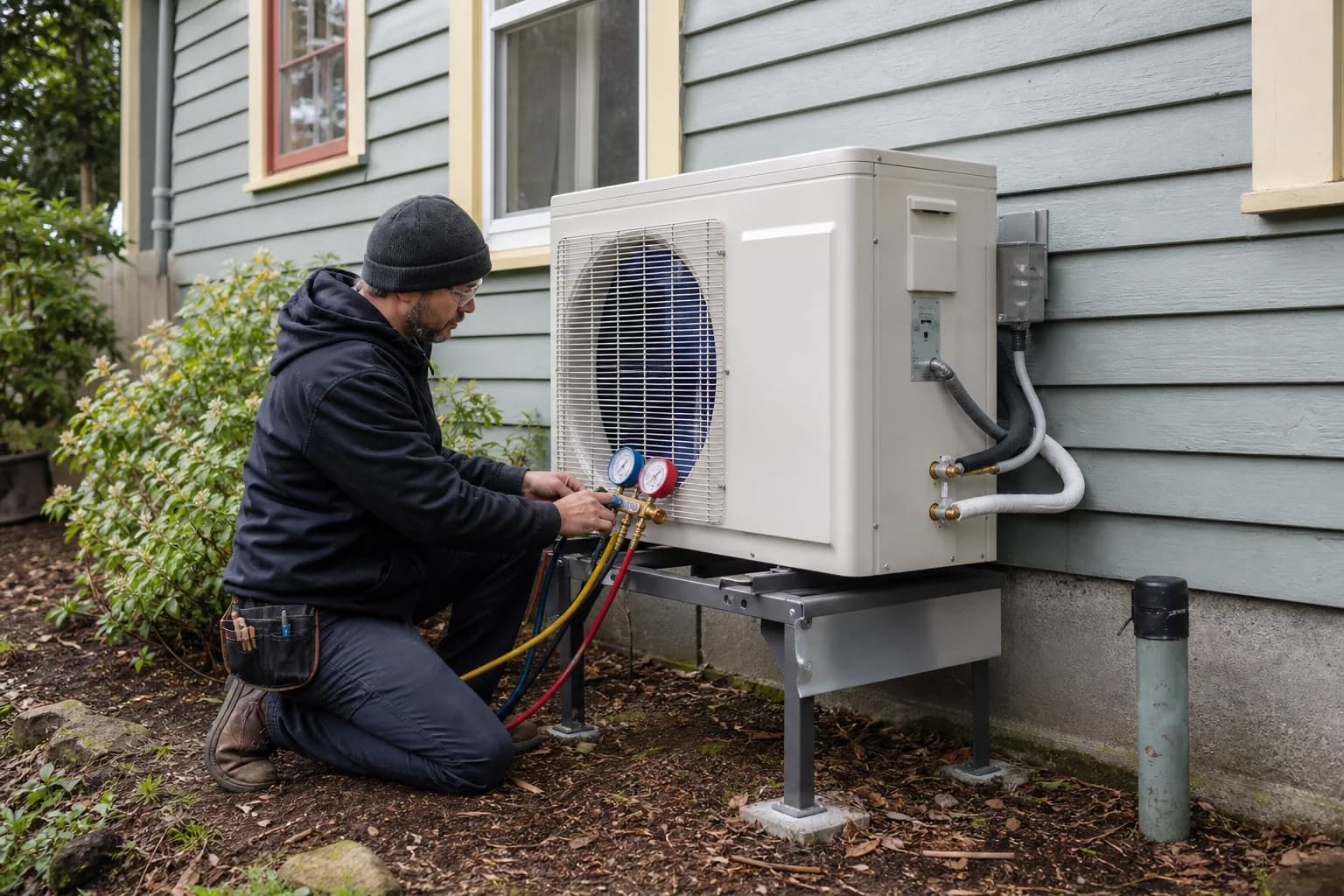
Eugene is one of the more favorable Oregon markets for heating oil to heat pump conversion because of three local factors that compound: EWEB (the Eugene Water and Electric Board) is a municipal utility that runs its own customer-side heat pump rebate program in addition to the Energy Trust of Oregon statewide layer; Lane County's pre-1925 housing stock concentration means most Eugene heating-oil homes never had ductwork, which steers the conversion toward ductless mini-split systems where ETO rebate tiers are highest; and EWEB's electricity rates have historically been among the lowest in Oregon, which makes the operating-cost comparison especially favorable against heating oil.
This guide covers the practical Lane County decision. Eugene-area HVAC contractors typically quote two main conversion paths: oil furnace to ductless mini-split (the dominant path for pre-1955 Eugene homes), and oil furnace to ducted heat pump (for the smaller share of Eugene homes with existing usable ductwork). Natural gas conversion via NW Natural is a third option but is now usually the third-place choice for Eugene retrofits when the long-term cost picture is run through.
For the gas-conversion alternative, see the existing oil tank replacement and gas conversion in Eugene guide. For the upstream tank decommissioning workflow, the Eugene oil tank removal pillar covers the tank side.
In this guide
- 01.Why Lane County is one of the best Oregon markets for heat pump conversion
- 02.EWEB and SUB: the Lane County utility incentive picture
- 03.Heat pump sizing for Eugene's climate (4C, marine)
- 04.Ductless mini-split vs ducted: the Eugene decision matrix
- 05.Sequencing the tank decommissioning and heat pump installation
- 06.Eugene-Springfield 2026 cost ranges, all-in after incentives
- 07.The UO rental economics: split incentives, lease cycles, and disclosure
- 08.Common Eugene homeowner mistakes on heat pump conversions
Why Lane County is one of the best Oregon markets for heat pump conversion
Four locally-specific factors make Eugene a stronger heat pump conversion market than Salem or Portland in 2026:
- 01.EWEB municipal utility incentive layer. EWEB is a customer-owned municipal utility (not investor-owned like PGE or Pacific Power) and operates its own customer-side energy programs. The EWEB Heat Pump Incentive Program adds EWEB-funded rebates on top of Energy Trust of Oregon's statewide rebate, with the amount depending on the specific equipment and the customer's income tier. Check EWEB's current program terms for the figures, which change year to year. Springfield properties get a similar layer from Springfield Utility Board (SUB) which mirrors EWEB's program structure.
- 02.EWEB electricity rates run low. As a customer-owned municipal utility, EWEB has historically priced residential electricity below the investor-owned Oregon utilities. Check the current published rate on your own bill, then compound it against a heat pump's coefficient of performance to get the real annual heating cost for your house.
- 03.Federal IRA 25C tax credit: $2,000 per year for qualifying heat pumps. The Inflation Reduction Act's residential energy efficiency credit applies the same in Eugene as anywhere; a non-refundable $2,000 against federal tax liability for qualifying installations.
- 04.Pre-1925 housing stock concentration drives ductless mini-split as the favored path. Most West University, Whiteaker, College Hill, and Jefferson Westside craftsman homes never had ductwork (radiator heat was the original installation). Ductless mini-splits are the natural conversion target; ETO's rebate tier for ductless systems in unducted homes is among the highest tiers in the program. Ductless retrofits are common work for Lane County contractors as a result.
- 05.Insurance non-renewal pressure on active oil tanks. Some Pacific Northwest carriers have tightened underwriting on active oil tanks. The conversion economics plus the insurance push combine to move timelines forward.
EWEB and SUB: the Lane County utility incentive picture
Eugene-Springfield electricity is split across three utility territories. Each has its own incentive program; the dollar amounts are broadly similar but the application workflows differ. Verify your utility before any conversion conversation.
- 01.EWEB (Eugene Water and Electric Board): most Eugene addresses inside the city limits. Customer-owned municipal utility. The EWEB Heat Pump Incentive Program layers on top of ETO, and the application is typically filed post-install. Income-qualified adders available for households at or below specified income thresholds; the threshold is set high enough that many middle-income UO faculty and Lane County state-employee households qualify.
- 02.Springfield Utility Board (SUB): Springfield addresses 97477 / 97478. Similar municipal-utility structure to EWEB; runs its own customer-side incentive layer on top of ETO. Rebate dollar amounts comparable to EWEB. Separate application portal.
- 03.Pacific Power: rural Lane County (Cottage Grove, Veneta, Junction City, parts of Florence corridor). Investor-owned utility. ETO administers the standard statewide rebate, and Pacific Power adds its own income-qualified layer on top. Confirm current eligibility and amounts with the utility before you budget.
- 04.EWEB and SUB are not in the ETO administration pool the same way PGE is. EWEB and SUB administer their own rebate programs that align with ETO standards but are funded and processed locally. That local processing is the reason Eugene and Springfield applications follow a different workflow from the statewide one.
Tip
Pull your most recent electric bill before talking to any HVAC contractor. The utility name is on the masthead. EWEB customers tell the contractor "EWEB Heat Pump Incentive Program" and the contractor handles the application; Springfield customers say "SUB"; rural Lane County customers say "Pacific Power". Each path has slightly different paperwork.
Heat pump sizing for Eugene's climate (4C, marine)
Eugene sits firmly in ASHRAE Climate Zone 4C (marine, moderately cold). Climate is slightly milder than Salem because Eugene sits a bit further south in the Willamette Valley with somewhat more marine influence funnelling up the river. Design temperatures are essentially identical to Salem's but the deep-cold frequency is lower.
- 01.Eugene 1 percent winter design temperature: approximately 22°F. The temperature that 99 percent of winter hours stay above. Heat pump sizing uses this as the cold-end reference.
- 02.Deep cold is rare in Lane County. Eugene sees only a handful of hours at or below 10°F in a typical winter. The cold-climate equipment that ETO subsidises heavily is technical overkill for this climate, but the rebate adder can still make it the cheaper net choice, so price both.
- 03.Standard ducted heat pump capacity threshold: 17°F at 100 percent capacity. Adequate for Eugene without backup. Most heating hours are above this; rare cold snaps pull in backup heat for a few hours.
- 04.Cold-climate heat pump: -5°F rating. Overkill for Eugene climate but often cost-effective anyway because of the ETO rebate adder. Ask the contractor to quote the equipment premium and the matching rebate adder side by side, since the adder can more than cover the premium.
- 05.Sizing by Manual J load calculation. Eugene's 1920s craftsman bungalows with original plaster walls and single-pane windows have very different heat loads than 1985 Cal Young ranches. Manual J is required. Reject any quote that does not include it.
- 06.Backup heat strategy. For most Eugene homes, electric resistance strip heat backup is adequate and rarely engages. Dual-fuel hybrid (heat pump + gas furnace) is uncommon in Eugene because gas service penetration is lower than Salem's and the strip-heat strategy is cheap enough not to bother with a dual fuel install.
Ductless mini-split vs ducted: the Eugene decision matrix
Eugene's housing stock makes the ductless mini-split the more common path, because most pre-1955 Eugene homes never had ductwork to reuse.
- 01.Pre-1955 Eugene homes (West University, Whiteaker, College Hill, Jefferson Westside, parts of Friendly Area): ductless mini-split path. Original heating was either radiator (steam or hot water) or floor-grate gravity furnace; no forced-air ductwork exists. Adding ductwork to retrofit is expensive ($5,000 to $10,000 of sheet-metal work) and often visually disruptive in older homes. Ductless mini-splits with 3 to 5 indoor heads are the standard answer.
- 02.1955-1985 Eugene homes (South Eugene, Cal Young, Crescent, parts of Whiteaker, Goshen, post-WWII Springfield): ducted heat pump path. Built with forced-air HVAC; ductwork already exists. Cheapest conversion, typically $9,000 to $14,000 installed, and it retains the central-air feel.
- 03.Post-1985 Eugene homes: nearly always already gas or already electric. The 1985-2000 stock was usually built with gas furnaces; the 2000+ stock increasingly with heat pumps from the start. Conversion-pillar audience is small in this cohort.
- 04.The Eugene ductwork-status check: open a wall register. If you can see a sheet-metal duct lined with insulation extending into the wall, you have ductwork. If you see a floor grate over an empty crawlspace plenum that just delivers warm air from a gravity furnace below, you do not have ductwork in the modern sense. The latter case (common in pre-1925 stock) requires the ductless path.
- 05.UO married-housing and university-area rentals: hybrid ductless. Some West University rentals have one or two zones of ductwork added 1970s-1980s as cheap retrofits; ductless mini-splits sometimes augment rather than replace these. Lane County HVAC contractors familiar with rental retrofits handle this scenario routinely.
Note
Get the Manual J load calculation and a ductwork inspection before signing any contract. Lane County's housing-stock variation means the same square footage can need very different system designs depending on insulation, window age, and ductwork status. A good Eugene HVAC contractor includes both in design phase.
Sequencing the tank decommissioning and heat pump installation
Tank decommissioning and heat pump install are separate workflows with separate contractors. Sequencing matters because permits, lab turnaround, and HVAC installation interact.
- 01.Step 1: tank locate and decommissioning permit application. Licensed DEQ HOT provider pulls the City of Eugene (or Springfield, or Lane County) permit. 5 to 14 days for permit issuance.
- 02.Step 2: tank pump-and-clean. Crew arrives, pumps residual fuel and sludge to vacuum truck for recycling, cleans tank to ASTM, verifies vapor-free. One day on site. Oil furnace can now be disconnected without flash-fire risk.
- 03.Step 3: oil furnace removal. HVAC contractor disconnects and removes the oil furnace, caps the supply line at the basement, removes oil-specific flue components. Often bundled with the heat pump install in a single visit.
- 04.Step 4: tank excavation or AIP fill. Removal or abandonment in place, depending on the lot. Soil samples pulled. Pit backfilled with clean fill, or tank filled with sand/CLSM in place. One to two days on site.
- 05.Step 5: heat pump installation. HVAC contractor installs outdoor condenser, indoor air handler or ductless heads, refrigerant line set, electrical disconnect, condensate drain. Typical timeline: 1 to 3 days. New electrical service may be needed if the panel cannot support the heat pump load (common on pre-1965 Eugene homes with original 100A or smaller panels).
- 06.Step 6: lab results + Decommissioning Report. Soil samples come back from ORELAP lab 7 to 21 days after collection (courier from Eugene to Tualatin/Clackamas/Portland adds a day each way). If clean, Decommissioning Report filed with DEQ Western Region inside 30 to 60 days. If contaminated, the OAR 340-122 cleanup pathway opens; heat pump is already operating so heating is not affected.
Tip
For UO rental conversions, schedule the entire workflow into the academic-year turnover window (mid-June to late August) when units are vacant. This eliminates tenant-disruption obligations under ORS 90 and lets the HVAC contractor work without coordinating around residents. Lane County HVAC contractors who serve the rental market plan their summer calendars around this; book by April for an August completion.
Eugene-Springfield 2026 cost ranges, all-in after incentives
Indicative equipment-plus-labor ranges for a complete oil-to-heat-pump conversion in Lane County, before incentives. The federal IRA, ETO, and EWEB or SUB layers all stack on top, but the amounts change year to year, so build your own net figure from the current published program terms rather than from a number on a web page.
- 01.Standard ducted heat pump (Eugene 1955+ home with usable ductwork). Equipment and labor typically $9,500 to $13,500 before incentives. Springfield works the same way with SUB rather than EWEB.
- 02.Cold-climate ducted heat pump (Eugene high-efficiency tier). Equipment and labor typically $11,000 to $15,500 before incentives. This tier usually carries the largest ETO rebate adder, which is why it can end up cheaper net than the standard tier.
- 03.Ductless mini-split system, 3 indoor heads (Eugene pre-1955 craftsman without ductwork). Equipment and labor typically $11,000 to $16,000 before incentives. The ductless-in-unducted-home tier is among ETO's highest, and this is the favored Lane County path.
- 04.Ductless mini-split system, 4 to 5 indoor heads (larger Eugene craftsman or four-square). Equipment and labor typically $13,500 to $19,500 before incentives.
- 05.Electric service upgrade (pre-1965 Eugene homes). Many West University, Whiteaker, and College Hill homes still run 60A or 100A original panels. Upgrading to 200A typically runs $2,500 to $4,500, and the panel itself is usually outside the heat pump rebate programs.
- 06.Tank decommissioning baseline (added to all paths). Typically $1,500 to $3,500 for removal and $1,200 to $2,800 for AIP. Not eligible for IRA or ETO incentives. See Eugene cost guide for the line-item breakdown.
The UO rental economics: split incentives, lease cycles, and disclosure
Eugene rental property heat pump conversions have economic considerations that owner-occupied retrofits do not. Three of these are Eugene-distinctive enough to warrant a dedicated section.
- 01.Split incentive: landlord pays install, tenant pays utility. A landlord paying $5,000 to install a heat pump cannot directly capture the operating-cost savings; the tenant does, because the tenant pays the electric bill. ETO and EWEB still subsidise the install (the rebates go to the property owner who paid for the work) but the landlord's direct payback comes through marketability and rent premium, not direct savings. Lane County UO-rental landlords increasingly see modernised HVAC as a competitive feature that supports higher rent or reduced vacancy.
- 02.Lease-cycle scheduling. Academic-year leases turn over June through August. Most UO rental retrofits are scheduled into this window to avoid mid-lease ORS 90 tenant-disruption obligations. Booking pressure on Lane County HVAC contractors peaks in May for August completions; conversions started in October typically wait until next summer for installation.
- 03.Cleanup cost on a rental sits with the owner. If the oil tank decommissioning reveals contamination, no state program offsets it, and DEQ places the obligation on the current owner of the property even if the leak predates the purchase. Rental status does not change that, and it does not affect rebate eligibility for the heat pump itself either.
- 04.Disclosure to current and prospective tenants. ORS 90 requires landlords to disclose ongoing repair or upgrade work to current tenants. Heat pump conversions during summer turnover sometimes overlap with new lease signings; the work-in-progress needs to be disclosed honestly to incoming tenants. Eugene property managers handle this routinely as part of the standard summer-turnover workflow.
Common Eugene homeowner mistakes on heat pump conversions
Five patterns the Lane County HVAC community sees repeatedly:
- 01.Defaulting to ducted heat pump in a pre-1925 home with no ductwork. Some contractors quote ducted heat pump installs that include $5,000 to $10,000 of new ductwork because the homeowner thought "central air" was the goal. For most West University and Whiteaker craftsman homes, ductless mini-splits are cheaper and work better. Get a ductless quote alongside any ducted quote.
- 02.Skipping the electrical panel upgrade quote. Lane County's older housing stock has more pre-1965 electrical service than most Oregon metros. Many West University and College Hill homes still run 60A original panels. A heat pump may not fit; upgrade is $2,500 to $4,500.
- 03.Not stacking the EWEB / SUB rebate on top of ETO. The municipal utility layer is easily missed by contractors who default to ETO-only thinking. Eugene-specific contractors should know to apply for both; verify on the quote.
- 04.Choosing ductless when ductwork would work. The 1965-1985 South Eugene and Cal Young stock has working ductwork. Ductless mini-splits cost more on top of equivalent ducted equipment and produce visible indoor heads that some homeowners do not want. If ductwork exists and works, use it.
- 05.Booking conversions in October hoping for November completion. Lane County HVAC contractors' peak season is heat-season emergency calls (November through February); new install scheduling typically pushes 6 to 12 weeks during that window. May to August is the easier scheduling window.
Get a quote
Ready to schedule a Eugene-area decommissioning?
Free site survey, fixed-price written quote, full DEQ closeout documentation filed at the East 7th Avenue office. Most surveys scheduled within 48 hours.
Request a Written QuoteConversion Guide: Common Questions
EWEB or ETO, which rebate do I apply for first?+
Both, but they are separate applications. The HVAC contractor typically handles the ETO statewide rebate at point of sale (instant rebate, applied to the invoice). The EWEB Heat Pump Incentive Program is usually a separate post-install application that the homeowner files with EWEB; some Lane County contractors will file it on the homeowner's behalf. Confirm the application workflow on the quote: who files which rebate, when, and how long until the money lands.
My home is a 1920 West University craftsman with no ductwork. Is heat pump even practical?+
Yes, and the ductless mini-split path is built for this exact home. 3 to 4 indoor heads (one per main living space; sometimes one shared between hallway and bedrooms) covers most West University craftsman floor plans well. Installed cost typically runs $11,000 to $16,000 before incentives, and the stacked federal, ETO and EWEB package comes off that. Lane County HVAC contractors do these retrofits routinely.
I own a UO rental. Does heat pump conversion make economic sense for me?+
Depends on the rent positioning and the unit. A converted unit can usually support a higher rent than an oil-furnace-equipped unit at the same location, and over a long enough hold that difference can exceed the landlord's net out-of-pocket on the install. Add in the reduced insurance pressure on the oil tank, which the landlord pays, and the avoided capital cost when the oil furnace would have needed replacement anyway. Run the numbers on your own unit and your own hold period rather than on a rule of thumb.
Will a heat pump heat my Eugene home in a cold snap?+
Yes. Standard heat pumps rate to 17°F at full capacity, and cold-climate models reach -5°F. Eugene's winter design temperature is around 22°F, and deep cold snaps below 15°F are brief and infrequent. The system uses backup heat (electric resistance strip in most installs) for those brief windows. Lane County does not need the aggressive cold-climate equipment that Bend or Klamath Falls do.
Why does Eugene's incentive stack work out higher than Portland?+
Because EWEB and SUB run their own customer-side incentive programs on top of the statewide ETO layer. PGE and Pacific Power administer ETO incentives but do not independently add a meaningful customer-side rebate the way EWEB does. The net effect is an additional Eugene-only layer stacked on top of what a customer elsewhere in Oregon would receive for the same equipment. Check EWEB's current program page for the amount.
How long is the conversion timeline in Eugene?+
Typical 4 to 8 weeks from contractor selection to operating heat pump. 2 weeks for permits (DEQ HOT permit, City of Eugene mechanical permit, possible electrical permit), 2 to 4 weeks for equipment delivery and crew scheduling, 3 to 5 days on site. Shoulder season (April to May, September to October) is easiest; peak winter season (December to February) is busy with emergency work and may push out by an additional 2 to 4 weeks. UO rental conversions almost always schedule into June through August.
Does the heat pump conversion affect resale value in Eugene?+
It helps. A DEQ-cleared tank record combined with modern HVAC removes two of the questions a buyer would otherwise raise during inspection, and it takes the oil-tank contingency off the table entirely. How much that is worth in dollars depends on the property and the market at the time, so treat any specific figure you are quoted with caution.
What if I just want to keep the oil furnace running for now?+
Legal as long as the tank is in active use. The decommissioning obligation under OAR 340-177 only kicks in when the tank goes out of service. Risks worth knowing: heating oil delivery prices have run $3.80 to $5.50 per gallon in Lane County for the 2024-2026 seasons, which is materially more expensive than EWEB electricity for an equivalent heat pump COP; and several Pacific Northwest carriers are tightening underwriting on active oil tanks. The "keep it running" path is rational for owners with strong cash-flow constraints or near-term sale plans but the long-run economics favor conversion.
Related services and references
Guide
Oil Tank Replacement and Gas Conversion in Eugene
The NW Natural gas-conversion alternative path.
Guide
Oil Tank Removal Eugene Pillar
The full decommissioning workflow that sits upstream of any conversion.
Guide
Abandon or Remove Your Eugene Oil Tank
Which decommissioning path fits your specific Eugene lot.
Guide
Oil Tank Removal Cost in Eugene
Decommissioning baseline pricing that adds to any conversion path.
Guide
Selling a Eugene Rental Property with an Oil Tank
Landlord considerations including the conversion-vs-decommission decision at sale.
Service
Underground Oil Tank Removal
Standard decommissioning workflow.