
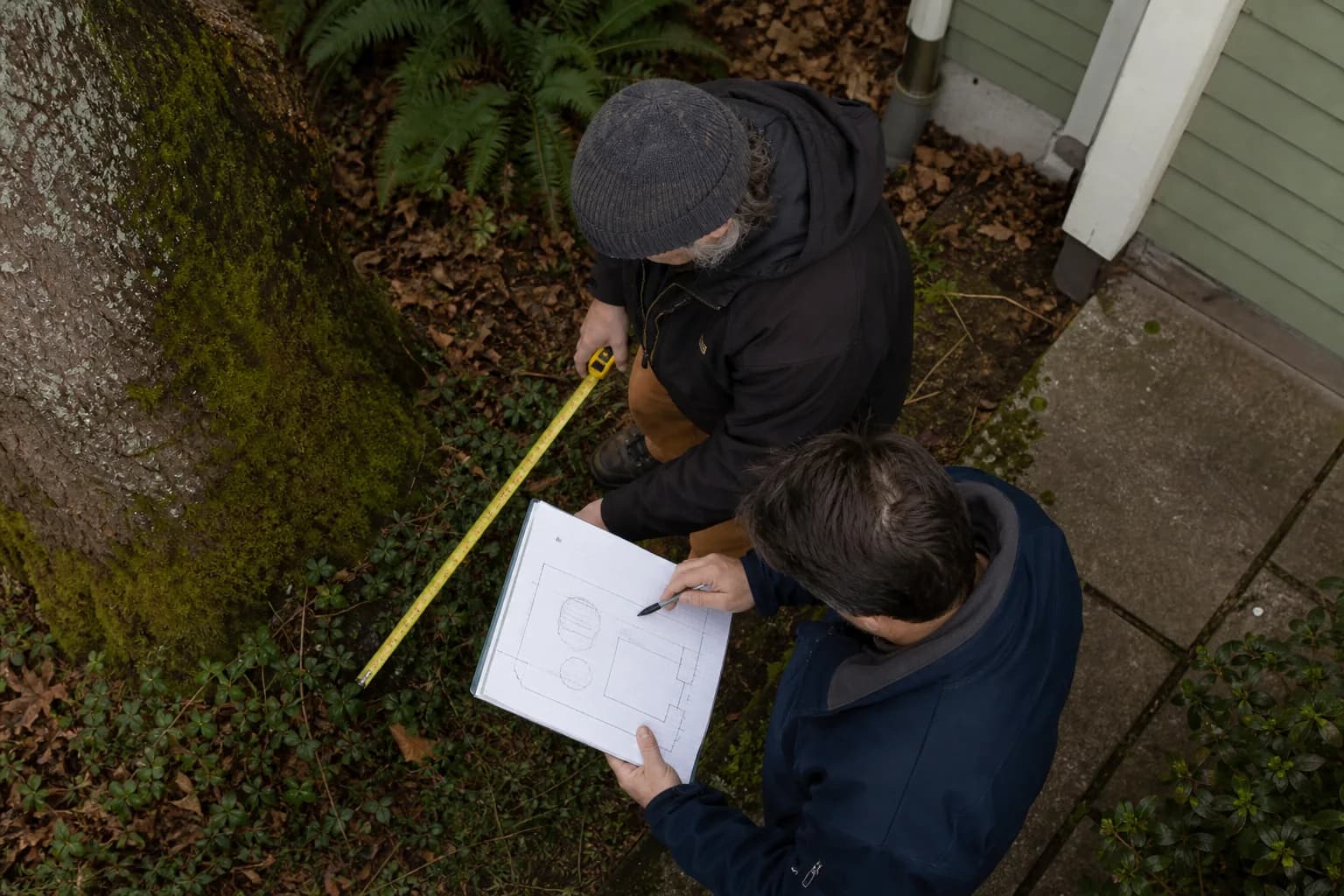
A minority of Eugene-Springfield underground heating oil tank decommissionings end as abandonment in place rather than removal, but the share is meaningful here because three Eugene-specific factors converge: a pre-1925 housing concentration with narrow side setbacks (West University, College Hill, Whiteaker), the City of Eugene Significant Tree ordinance which actively protects mature canopy in older neighborhoods, and a UO student-rental inventory where lease-cycle disruption pushes landlords toward the less-invasive option.
Oregon DEQ recognises both paths as valid. Same Decommissioning Report at the end, same DEQ HOT Program filing, same TPH-Dx and BTEX sampling protocol. The decision is not "do the work the right way vs do it cheap"; it is "remove vs leave in place, given the specific obstacle at this lot." This pillar walks the decision honestly for Lane County: when abandonment is genuinely correct, when removal is the only defensible answer, what the Eugene-Springfield cost gap actually looks like in 2026, and how each path reads at resale.
For the broader workflow around either path, the Eugene oil tank removal pillar covers the routine process. For what happens when sampling on either path reveals contamination, Eugene soil contamination and DEQ cleanup covers the release side. The abandonment-in-place service page covers the technical workflow.
In this guide
- 01.What OAR 340-177 actually says, and how DEQ Western Region reads it
- 02.The five scenarios where AIP is genuinely right in Lane County
- 03.The five scenarios where removal is the only defensible Eugene choice
- 04.What the Eugene-Springfield cost difference actually looks like in 2026
- 05.Soil samples: same protocol, different access
- 06.How the choice reads at resale in the Eugene market
- 07.The Eugene-Springfield permitting picture and the tree-code overlay
- 08.Common Eugene homeowner mistakes on this decision
What OAR 340-177 actually says, and how DEQ Western Region reads it
Oregon's Heating Oil Tank rule, codified at OAR 340-177, gives a licensed service provider two routes to close an out-of-service residential UST. DEQ Western Region in Eugene reviews both equally, and neither path automatically gets extra scrutiny, but Western Region staff are familiar enough with the Lane County licensed-provider community to spot proposals where AIP is being used as a budget shortcut rather than a genuine structural answer.
- 01.Removal. Excavate the pit, pump and clean, cut the steel, lift out, recycle. The pit is open; soil samples come from clean walls and floor; backfill with clean fill compacted in lifts. Most Lane County UST decommissionings end here.
- 02.Abandonment in place (AIP). Pump and clean through an access port without excavating, fill the empty tank with sand or controlled low-strength material (CLSM, lean concrete), cap the openings. Soil samples come through boreholes around the tank perimeter rather than from an open pit.
- 03.Both produce a Decommissioning Report. Same analyte panel, same ORELAP-accredited laboratory, same filing obligation to DEQ Western Region. The Report records "removal" or "AIP" against the property in the public Heating Oil Tank database.
- 04.DEQ does not let you choose AIP to save money. AIP is allowed when removal would damage permanent structures or is impractical. It is not a budget option for a clean removal case. DEQ Western Region knows the Lane County providers who push AIP without justification; Reports from those providers get extra review.
Watch out
The Decommissioning Report needs to document the specific structural reason AIP applies, meaning which permanent structure removal would damage and why excavation around it is impractical. A proposal that just says "we recommend AIP" without that justification produces a thin DEQ submission and a less marketable property record. Eugene's small licensed-provider pool means DEQ Western Region staff read these Reports closely.
The five scenarios where AIP is genuinely right in Lane County
Five typical Eugene-Springfield situations make abandonment in place the structurally correct path rather than a corner-cut. Three of them are far more common in Eugene than in any other Oregon metro because of the older-housing concentration and the city's tree ordinance.
- 01.Tank inside the Significant Tree critical root zone. The City of Eugene Significant Tree ordinance protects trees over a specified DBH (diameter at breast height) threshold in residential zones, and excavation inside a Significant Tree's critical root zone, typically a one-foot radius per inch of trunk diameter, requires a separate permit and may not be approved. West University, College Hill, the Whiteaker, and South Eugene have dense mature canopy, and on those blocks the tree is often the binding constraint. AIP preserves the tree.
- 02.Tank within excavation clearance of a foundation on a narrow setback. Pre-1925 craftsman bungalows in West University and the Whiteaker often sit on 50-foot lots with five-foot side setbacks. A tank placed three to four feet from the foundation has no excavation clearance without shoring or risking footing undermining in Eugene's silty clay loam. AIP is the careful path.
- 03.Tank under a permanent driveway extension or garage slab. Common pattern on 1955 to 1975 South Eugene and Cal Young homes where the original garage was extended over yard space. Removal means cutting and re-pouring concrete, $4,500 to $9,000 of demolition and replacement on top of the decommissioning. AIP avoids the concrete impact.
- 04.Tank on a UO rental with lease-cycle constraint. Eugene-specific scenario. A landlord facing a release call on a property with an academic-year lease running through August has limited options: pause the cleanup until summer turnover (and risk DEQ pushback on an open file), or use AIP to minimise the on-site disruption window. Removal with full excavation can take a yard out of commission for two to three weeks; AIP is typically a one-day visit with smaller equipment. For UO landlords, the lease-cycle factor often tips the decision even when access geometry would technically allow either path.
- 05.Tank in a basement or partial-basement crawl space where stair geometry blocks removal. Common on 1900-1930 South Eugene and West University homes with original cellar-stair geometry that physically prevents getting a 275-gallon oval tank out without cutting through floor joists. Cutting the tank in place, capping the openings, filling with CLSM is the AIP path.
The five scenarios where removal is the only defensible Eugene choice
Conversely, certain Lane County situations make removal essentially mandatory. If you fit one of these, a licensed provider proposing AIP is the wrong provider for the job.
- 01.Active or suspected leak. Once a release is on the table, the pit has to be opened to characterize the extent. AIP at a suspected-release site forecloses any future ability to verify the contamination boundary without re-excavating. DEQ Western Region will reject AIP for any tank with field-screen indicators of a release.
- 02.Real-estate transaction where the buyer requires removal. Some buyers, particularly those unfamiliar with Oregon's heating oil tank rules, read "abandoned in place" as something unresolved and make removal a closing condition. When that happens the AIP savings disappear, and they disappear entirely if the transaction falls through.
- 03.Tank in an open Cal Young or South Hills yard with clear access and no structural conflict. Newer Eugene neighborhoods (1965+) have wider setbacks and fewer mature trees; AIP justification is harder to defend in these contexts. If access is mechanically straightforward, removal produces the cleaner database entry.
- 04.Property in a shallow-groundwater corridor near the Willamette-McKenzie confluence. North River Road, Santa Clara, and parts of Bethel sit over shallow groundwater. AIP in shallow groundwater raises long-term integrity questions; CLSM fill is designed for above-water-table conditions. Removal eliminates the variable.
- 05.Tank with documented prior leak repairs. Patches and sleeve liners on the record undermine the structural integrity assumption that justifies AIP fill.
Note
When access is clear and there is no specific Lane County constraint (tree, setback, rental cycle, basement geometry), remove. Eugene's AIP rate is structurally elevated because the constraints are real and common — but they need to be the actual reason for the choice, not a post-hoc justification for the cheaper option.
What the Eugene-Springfield cost difference actually looks like in 2026
AIP saves money but less than most homeowners assume. Most of a decommissioning cost is permit, pump-and-clean, sampling, lab fees, disposal, and Report drafting, and AIP avoids none of it. Indicative Lane County 2026 ranges:
- 01.Clean underground tank removal (Eugene-Springfield): typically $1,500 to $3,500. Permit (City of Eugene, Springfield, or Lane County depending on address), locate, excavate, pump and clean, cut and remove, soil samples, backfill, ORELAP lab fees, Decommissioning Report. Steel goes to a Lane County scrap recycler.
- 02.Clean abandonment in place (Eugene-Springfield): typically $1,200 to $2,800. Permit, locate, pump and clean through access port, soil samples through boreholes, sand or CLSM fill, cap openings, Decommissioning Report. Typical savings run around $300 to $700 versus full removal, which is narrower than most owners expect.
- 03.AIP with Significant Tree documentation adder: $1,800 to $3,100. AIP cases where the structural justification is tree-canopy preservation typically include an arborist letter documenting the critical root zone impact, which DEQ Western Region uses as the structural justification in the Report. The arborist documentation adds $300 to $600.
- 04.Removal with concrete demolition adder: $4,500 to $9,000. When removal requires cutting and replacing a driveway slab, garage extension, or sidewalk approach. Common on South Eugene and Cal Young properties. The demo adder is exactly the case where AIP is the structurally correct choice.
- 05.CLSM fill from regional plants: $200 to $500 added. Most Eugene providers use sand for typical 275-gallon AIP fills; CLSM is used for larger tanks and shallow-groundwater locations. Mix comes from Lane County concrete suppliers; pour-day scheduling can add a day to the timeline because CLSM has limited shelf life.
Tip
If a Eugene provider quotes AIP at the same price as removal, ask why. If they quote AIP at half the cost of removal, that quote almost certainly skips required steps (one borehole instead of three, sand instead of CLSM where CLSM is required, no Significant Tree documentation where the constraint is tree-canopy). The honest 2026 gap on a 275-gallon Eugene UST is around $300 to $700.
Soil samples: same protocol, different access
A persistent misconception in the Eugene market is that AIP lets you skip soil testing. It does not. OAR 340-177 requires the same TPH-Dx and BTEX panel from the tank pit area regardless of path. What differs is access.
- 01.Removal sampling. Two to four samples from the open pit: one beneath each end of the tank footprint, one at the deepest point, one stockpile sample if soil was set aside. The licensed provider has direct visual access; suspected hot spots can be sampled in real time.
- 02.AIP sampling. Two to four samples through dedicated boreholes around the tank, drilled with a Geoprobe or hand auger to a depth equivalent to the tank footprint. Sample locations are diagrammed against the (unexcavated) tank position on the Decommissioning Report.
- 03.Lane County AIP sampling tends to be denser. Experienced Eugene licensed providers pull 5 to 6 boreholes on AIP cases rather than the 2 to 3 some Portland-area providers do. The reasoning: Eugene's pre-1925 tank inventory has a higher base-rate failure pattern, and DEQ Western Region's closer review of Lane County AIP Reports rewards the denser sampling.
- 04.An AIP release call closes the path. If borehole samples come back over the cleanup level, the case becomes a Cleanup Rule file and the tank has to be excavated anyway to characterize extent. AIP does not protect against a release call; it just changes the access pattern for confirming it. See Eugene soil contamination and DEQ cleanup for the cleanup workflow.
How the choice reads at resale in the Eugene market
The DEQ Heating Oil Tank database is public and searchable. Both "removal" and "abandonment in place" entries close the regulatory file, but they can read differently to a buyer.
- 01.Out-of-state buyers read removal cleaner. Buyers arriving from states without Oregon's heating oil tank rules are often unfamiliar with the AIP concept entirely. "Abandoned in place" reads as something unfinished, while "removed" reads as resolved, even when the regulatory file is equally closed in both cases.
- 02.UO faculty and grad-student buyers tend to be detail-oriented. A meaningful Eugene buyer segment is local UO faculty, staff, and grad-student couples buying their first home. This segment reads property records carefully and asks follow-up questions; AIP with strong Significant Tree documentation lands well, AIP without justification does not.
- 03.Lender behavior varies. Some local lenders are familiar with both paths and will process AIP with the Decommissioning Report attached. Others, and underwriters on federally backed loans in particular, may ask for additional documentation. Ask your loan officer early rather than at the closing table.
- 04.The Decommissioning Report is the key document either way. Whichever path you choose, the Report is what the buyer's lender and title insurance will ask for. A properly filed Report with documented justification for AIP essentially equalises the two paths in most Eugene transactions.
Tip
If you are planning to sell within five years, choose removal where it is structurally possible. The marginal gain is resale clarity rather than any regulatory advantage. If you are staying long-term and AIP is the structurally correct path, AIP with strong documentation is fine.
The Eugene-Springfield permitting picture and the tree-code overlay
Lane County decommissioning permits go through one of three jurisdictions depending on property address. Cost is similar across all three; what differs is the tree-canopy overlay, which is materially stricter in the City of Eugene than in Salem or Portland.
- 01.City of Eugene (most Eugene addresses). Permit through City of Eugene Permit Center. Typical turnaround 5 to 10 business days. Standard decommissioning permit covers both removal and AIP; the Significant Tree overlay is the distinct overlay you may encounter.
- 02.City of Springfield (97477 / 97478). Separate permit system through Springfield Development & Public Works. Turnaround 7 to 12 business days. Springfield does not have the same Significant Tree ordinance density as Eugene but does have its own tree protections.
- 03.Lane County unincorporated (Cottage Grove, Veneta, Junction City, rural). Permit through Lane County Land Management. Turnaround 7 to 14 business days. Tree-canopy constraints are lighter outside city limits; AIP rate trends lower in rural Lane County because there are fewer of the geometric constraints common in Eugene's urban core.
- 04.City of Eugene Significant Tree ordinance overlay. Eugene's tree code protects trees above a specified DBH threshold in residential zones. Excavation that extends into a Significant Tree's critical root zone requires a separate Significant Tree permit, sometimes with an arborist letter. This is the case where AIP is often the simpler path; the tree-preservation overlay is the structural justification the licensed provider documents in the Decommissioning Report.
Common Eugene homeowner mistakes on this decision
Five patterns the Lane County licensed-provider community sees repeatedly:
- 01.Defaulting to AIP because "Eugene tends toward AIP". The aggregate AIP rate is high in Lane County but the individual decision still needs structural justification. "My neighbor did AIP" is not a sufficient reason. Walk through the specific obstacle at your lot.
- 02.Choosing removal on a UO rental with an active lease. The lease-cycle constraint is a legitimate AIP justification for Eugene landlords. Removal during an academic-year lease creates tenant-disruption exposure that AIP largely avoids. If the property is owner-occupied, this factor does not apply.
- 03.Not getting the arborist letter when tree-canopy is the justification. If the Significant Tree overlay is why AIP applies, the arborist letter documenting the critical root zone impact is what makes the Decommissioning Report defensible. Without it, a future buyer or DEQ reviewer sees "AIP" without the why.
- 04.Pricing AIP and removal against each other without considering the demo adder. The relevant cost comparison on a tank under a driveway extension is AIP at $1,500 vs removal at $7,000 (removal plus demolition plus re-pour). Comparing AIP to a baseline $2,500 removal misses the structural-constraint adder that exists on the lot in question.
- 05.Treating AIP as faster. AIP and removal both take 1 to 2 working days on site. Timeline drivers are permit issuance and lab turnaround, which do not change between paths. If timeline is the constraint (lease-cycle, escrow), the answer is permit-pull speed, not path choice.
Get a quote
Ready to schedule a Eugene-area decommissioning?
Free site survey, fixed-price written quote, full DEQ closeout documentation filed at the East 7th Avenue office. Most surveys scheduled within 48 hours.
Request a Written QuoteDecision Guide: Common Questions
My West University craftsman has a five-foot side setback. Is AIP the obvious answer?+
Often, but verify the geometry first. If the tank sits less than four feet from the foundation, open excavation without shoring risks footing undermining in Eugene's silty clay loam — that is the AIP justification. If the tank is closer to the property line than to the foundation, the property-line clearance issue becomes the binding constraint instead. A licensed Eugene provider familiar with West University craftsman geometry will measure both clearances on site and document whichever is the binding structural constraint in the Decommissioning Report.
The tank is under a Significant Tree. How does that work?+
The City of Eugene Significant Tree ordinance protects trees above the DBH threshold from excavation impacts in the critical root zone (typically a one-foot radius per inch of trunk diameter). If excavation would impact the CRZ, a separate Significant Tree permit applies and may not be approved. Most Lane County licensed providers in this situation will recommend AIP with an arborist letter documenting the CRZ impact, which becomes the structural justification in the Decommissioning Report. The arborist letter typically adds $300 to $600.
I am in Springfield, not Eugene. Does the path decision change?+
The DEQ rule is statewide; what differs is permitting. Springfield Development & Public Works processes the permit rather than City of Eugene Permit Center, so confirm the fee and turnaround with Springfield rather than assuming Eugene figures carry across. Springfield does not have the same Significant Tree density as Eugene proper, so the tree-canopy justification for AIP applies less often. Decision logic otherwise unchanged: remove if access is clear, AIP if there is a real obstacle.
I rent the property to UO students. Does that justify AIP?+
It can. A property with an academic-year lease running through August faces a real disruption issue if the cleanup requires two to three weeks of yard access. AIP's smaller equipment footprint and one-day on-site visit materially reduces the tenant-disruption window, which is a legitimate AIP justification for UO-landlord cases. If the lease ends in June or August and the work can be scheduled into that window, the rental constraint may not apply. For mid-lease releases, though, AIP is often the structurally correct answer for a different reason than owner-occupied properties.
Does it matter that a buyer might not understand what abandonment in place means?+
Indirectly, yes. Buyers unfamiliar with Oregon's heating oil tank rules often read "abandoned in place" as something unresolved, even when the regulatory file is fully closed. If you plan to sell within five years, that argues for removal where structurally possible. If you are staying long-term, the effect at an eventual resale is too far out to factor heavily.
My provider quoted AIP at the same price as removal. Is that suspicious?+
Worth asking why. Some Eugene providers price the two paths similarly because the labor savings on AIP get offset by the additional borehole-sampling work and CLSM fill on larger tanks. If access is mechanically straightforward, that pricing tells you to choose removal for the cleaner database entry. If the prices are identical because the AIP scope was thinned (fewer boreholes, sand instead of CLSM where CLSM should apply, no Significant Tree documentation), that is a separate concern about scope completeness.
Will the buried tank cause future problems if I abandon it in place?+
Properly filled with sand or CLSM, no. The fill keeps the void from collapsing as the steel corrodes over decades. The only future issue is if surface excavation (a future addition, a new driveway, utility work) needs to pass through the filled tank, in which case the AIP fill has to be excavated and the steel removed at that time. That is a future-owner expense, not a defect. Cost to remove a properly AIPed tank later: $2,500 to $4,500 in 2026 Lane County dollars.
Does NW Natural gas conversion affect the path decision?+
Not typically. NW Natural conversion work prefers the heating oil tank decommissioned before the gas line is energised, but the conversion contractor does not generally care whether the path is removal or AIP. Both close the regulatory file. The path driver is the structural reality of your lot, not the gas conversion. See oil tank replacement and gas conversion in Eugene for the conversion timing picture.
Related services and references
Service
Oil Tank Abandonment in Place
Technical workflow for AIP: pump, clean, sample through boreholes, CLSM fill, file Report.
Service
Underground Oil Tank Removal
Full UST decommissioning: excavate, pump, cut, remove, sample, backfill, file Report.
Guide
Oil Tank Removal Eugene Pillar
The master decommissioning hub: when removal is required, what the work involves, what it costs.
Guide
Oil Tank Soil Contamination Eugene
What happens when borehole or pit samples come back over the cleanup level.
Guide
Find a Buried Oil Tank in Eugene
Discovery side: visual indicators by neighborhood.
Guide
Oil Tank Removal Cost in Eugene
Detailed 2026 Eugene pricing for both removal and abandonment scopes.