
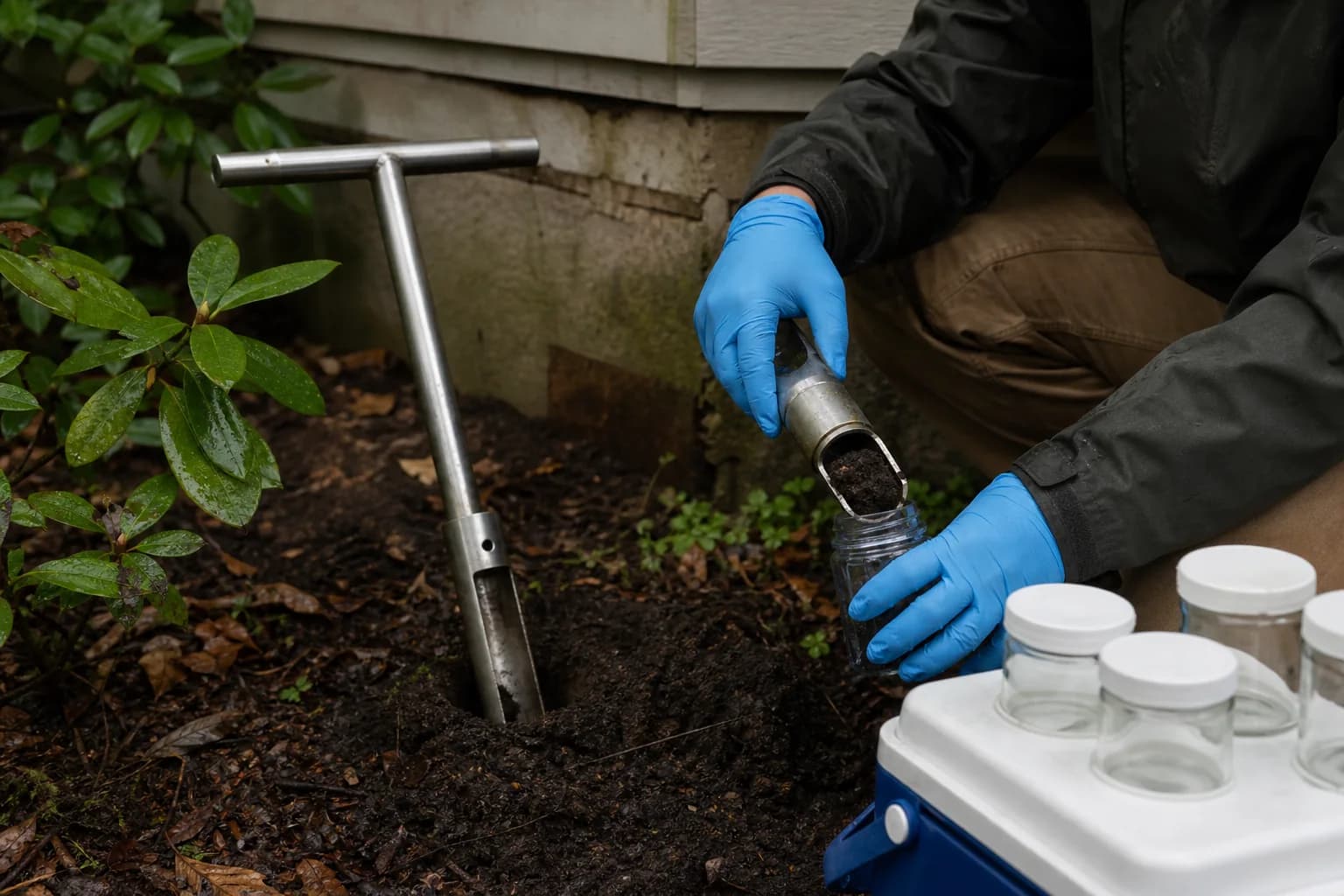
A minority of Eugene-Springfield underground heating oil tank decommissionings turn up at least some soil exceedance. Eugene's older-housing concentration is geographically tight: pre-1949 single-wall steel inventory dominates West University, College Hill, the Whiteaker, and Jefferson Westside, and the failure curve on 70-plus-year-old steel is steep.
Oregon regulates residential heating oil releases under OAR 340-122. The DEQ Western Region office on East 7th Avenue in Eugene processes Lane, Linn, Benton, Lincoln, and parts of Douglas County. Cleanup Report acceptance timing depends on lab turnaround and DEQ review, and it varies from case to case. The screening levels and analytes are statewide; what differs in Lane County is the licensed-provider pool, the Short Mountain Landfill disposal logistics, the EWEB McKenzie source-water overlay near North River Road, and the UO student-rental cycle pressure on cleanup timelines.
For the routine decommissioning workflow that sits upstream of any release call, the Eugene oil tank removal pillar covers the front half. For where pre-1985 tanks tend to hide in Eugene's older blocks specifically, find a buried oil tank in Eugene walks through the visual indicators by neighborhood.
In this guide
- 01.How a Eugene release actually gets confirmed
- 02.TPH-Dx and BTEX: what your Eugene lab report actually shows
- 03.DEQ residential cleanup levels: what the numbers mean in the Eugene context
- 04.The Eugene cleanup workflow: from confirmed release to No Further Action
- 05.What a Eugene cleanup actually costs in 2026
- 06.Where your property sits decides which cleanup pathway you can reach
- 07.Insurance, pollution liability, and who pays in Lane County
- 08.A Eugene-specific wrinkle: rental exposure and the UO calendar
- 09.Choosing a cleanup contractor in the Eugene-Springfield market
How a Eugene release actually gets confirmed
Three pathways open a Lane County release file. Each looks different on the homeowner side; they all end at the DEQ Western Region desk in Eugene, which handles Lane, Linn, Benton, Lincoln, and parts of Douglas County. The Western Region queue is smaller than DEQ HQ in Portland, which means Cleanup Report acceptance and No Further Action turnarounds run materially faster than in the urban corridor.
- 01.Field-visual or olfactory detection at decommissioning. Crew opens the pit on a Whiteaker or West University tank that was installed 1925 to 1955. Seventy-plus years of single-wall steel in Willamette Valley silty clay loam makes pinhole corrosion statistically inevitable; the soil under the tank shows oil. Photoionisation detector confirms in the field; samples ship to the lab regardless. About half of confirmed Eugene releases on pre-WWII inventory are first noticed this way.
- 02.Lab analytical exceedance on a visually clean pit. Pit looks fine, samples ship out of Eugene to the ORELAP-accredited lab, TPH-Dx or BTEX comes back over the residential cleanup level. Most common pathway in Eugene because the silty clay loam in older neighborhoods holds petroleum without obvious staining; small chronic seepage shows up only in the lab number. Sample-to-PDF turnaround on a Eugene pickup runs 5 to 8 business days: courier leaves by 4pm, arrives Tualatin or Clackamas next morning, analysis 3 to 5 business days, report delivered shortly after.
- 03.Off-property indicator. A neighbor's well test, a stormwater catch-basin sample tied to Amazon Creek or the Long Tom River, or an EWEB source-water flag near the lower McKenzie corridor traces heating oil markers to your tank. Rare but not theoretical: properties in the North River Road and Santa Clara strip near the Willamette-McKenzie confluence occasionally surface this way. EWEB takes McKenzie source-water seriously and will coordinate with DEQ Western Region when traces appear in routine sampling.
Note
A photoionisation detector hit in the field is not a regulatory call. High PID readings trigger more sampling; the ORELAP lab number on the certified report opens or closes the file. Field instruments cannot substitute for lab-certified results, and DEQ Western Region will not accept field-only data on a Cleanup Report.
TPH-Dx and BTEX: what your Eugene lab report actually shows
Once the licensed provider couriers your samples out of Eugene, two analyte panels generate the numbers that drive every downstream decision. The same ORELAP-accredited laboratory runs both panels on the same soil aliquot. Lane County does not have its own ORELAP-accredited heating-oil lab, so samples ship north by courier.
- 01.TPH-Dx (total petroleum hydrocarbons, diesel range), method NWTPH-Dx. Heating oil is chemically diesel; the lab quantifies the C10 to C24 carbon-chain range in milligrams per kilogram of soil. This is the bulk indicator most Eugene-Springfield cases pass or fail on. Some labs report the NWTPH-HCID hydrocarbon-identification variant alongside, which rules in or out commingled gasoline contamination — useful on Whiteaker or College Hill lots where pre-war structures sometimes had both a heating-oil tank and a gasoline storage tank in the same yard.
- 02.BTEX (benzene, toluene, ethylbenzene, xylenes), EPA method 8260. Trace aromatic constituents inside heating oil. Benzene is the binding constituent because of its mobility in groundwater and its EPA-listed carcinogenicity. A benzene exceedance alone, even with TPH-Dx sitting just below the bulk threshold, opens a Cleanup Rule file. Most Eugene cases where this matters are basement tanks in older homes with prior small product leaks soaking into foundation soil.
- 03.Sample locations follow DEQ guidance. Two beneath the tank footprint (one each end), one at the deepest pit point, one stockpile sample if any soil was pulled. On a Cal Young or Crescent ranch pad-mount AST removal the stockpile and footprint samples may be the entire scope; on a Whiteaker UST excavation the lab usually runs four to six samples.
Tip
When the PDF arrives, the most useful number is the TPH-Dx line per sample location in mg/kg, compared against the cleanup level on the next page. A result of "ND" (not detected) is the cleanest possible outcome. A result above the screening level on any single location is a release call until RBDM site-specific levels are negotiated with DEQ Western Region.
DEQ residential cleanup levels: what the numbers mean in the Eugene context
DEQ publishes generic residential cleanup levels in the Risk-Based Concentration tables. The values are statewide, but they play differently in Eugene than in Salem or Portland because the groundwater depth varies dramatically by neighborhood and because the McKenzie River source-water for EWEB sits in the watershed.
- 01.Your cleanup level is assigned to the site, not to the contaminant. DEQ's soil matrix sets three petroleum hydrocarbon levels: Level I at 100 ppm, Level II at 500 ppm, and Level III at 1,000 ppm. A Lane County property scores into one of them on five criteria, one of which is depth to groundwater. That is the mechanism behind something Eugene owners notice anecdotally, which is that River Road and Santa Clara addresses seem to get held to a harder standard than the South Hills.
- 02.Fifty milligrams per kilogram is the line that starts everything. A diesel-range result at or above 50 mg/kg by NWTPH-Dx is a below-ground release and triggers reporting. It is not the level you clean to, and reading it as one is why homeowners sometimes think a modest exceedance means a total excavation.
- 03.Toluene, ethylbenzene, xylenes: 1 to 15 mg/kg each. Lower priority. Cleanup decisions rarely turn on T/E/X alone; benzene is usually the binding constituent.
- 04.Groundwater levels apply when the water table is shallow. Eugene groundwater depth ranges wildly by neighborhood. South Hills properties sit well above the regional water table, and tank pits in South Eugene rarely intercept water. North River Road and Santa Clara properties near the Willamette-McKenzie confluence sit over shallow groundwater, and tank pits there regularly hit water during excavation. When that happens, the cleanup-level calculation shifts from soil mg/kg to groundwater µg/L and the numbers tighten by two to three orders of magnitude.
- 05.EWEB source-water buffer adds scrutiny near the McKenzie. Properties within EWEB's drinking-water source-area boundary along the lower McKenzie corridor get an extra DEQ Western Region attention layer. Cleanup levels stay the same; the file is reviewed more carefully and closure tends to run longer.
Watch out
A sample over the residential level is not automatically a $30,000 cleanup. Oregon's risk-based decision-making framework allows site-specific cleanup levels for depth, distance-to-receptor, and soil type. The Eugene-Springfield licensed-provider pool is small enough that DEQ Western Region staff know individual providers by name; RBDM negotiations in Lane County tend to move faster than in larger urban queues because the working relationships are already there. Always ask whether RBDM applies before committing to a dig-and-dump.
The Eugene cleanup workflow: from confirmed release to No Further Action
Once a release is confirmed by lab results, the file transitions to a DEQ Cleanup Rule case. The licensed service provider who did the original decommissioning usually carries the cleanup unless the case complexity calls for a separate environmental consultant. DEQ Western Region processes Lane County files more quickly than Portland or Medford because the queue is smaller.
- 01.Step 1: site characterization, $2,000 to $5,000. Step-out borings around the original pit, each sampled at multiple depths. Eugene rule of thumb: four to six borings at 5, 10, and 15 feet on a standard urban UST footprint. Vertical extent matters more here than in many Oregon markets because of the elevation drop into the Willamette-McKenzie confluence on north-Eugene properties.
- 02.Step 2: cleanup plan. For simple Tier 1 cases this is a one-page scope. For Tier 2 or 3 the provider submits a full work plan to DEQ Western Region for concurrence; typical Eugene turnaround is 10 to 21 business days. Springfield properties (97477 / 97478) route through the same office.
- 03.Step 3: excavation and confirmation sampling. Crew excavates the contaminated soil, stockpiles on poly liner, pulls confirmation samples from new pit walls and floor. Wet-season excavation (October to April) often gets postponed because Lane County clay-rich subsoils hold water; functional cleanup season in the South Willamette is May through September.
- 04.Step 4: off-site disposal at Short Mountain Landfill. Petroleum-contaminated soil for non-hazardous loads goes to Short Mountain Landfill, 12 to 15 miles south of central Eugene off Highway 99 near Goshen. Lane County operates the facility and requires a special waste permit before petroleum-contaminated soil is delivered, with the material meeting Lane County acceptance standards. Coffin Butte Landfill in Benton County also accepts petroleum-contaminated soil, and higher-concentration loads sometimes route further afield.
- 05.Step 5: backfill and restoration. Clean fill, compacted in lifts, surface restored. Eugene urban-tree retention rules sometimes require careful work around mature street trees; the City of Eugene Urban Forestry permit may apply if excavation extends into a critical root zone, common on West University and College Hill lots.
- 06.Step 6: Cleanup Report and No Further Action. Provider compiles lab results, manifests, photos, and narrative into a Cleanup Report submitted to DEQ Western Region. NFA timing depends on lab turnaround and DEQ review, and it varies. NFA closes the case and gets recorded in the public Heating Oil Tank database.
Note
No Further Action on file is a marketable outcome, not a black mark. Eugene-area title companies and buyers interpret an NFA letter as "this property was tested, found to have a release, cleaned to residential standards, and closed by the state regulator" — materially better than an untested property with an unknown tank. Lane County title companies process NFA properties without friction.
What a Eugene cleanup actually costs in 2026
Cleanup cost depends almost entirely on how much soil has to come out. Three rough tiers cover the typical Lane County distribution. Numbers reflect 2026 quotes inside Eugene 97401 to 97408 and Springfield 97477 to 97478; rural Lane County (Cottage Grove, Veneta, Junction City) and the Coast Range run different rates because of haul distance to Short Mountain.
- 01.Tier 1: localised exceedance, typically $3,500 to $12,000. One or two samples over the level. Crew extends the pit two to six feet, pulls confirmation samples, hauls the contaminated soil to Short Mountain. This is the usual outcome when a release is confirmed.
- 02.Tier 2: defined release with full characterization, typically $12,000 to $28,000. Step-out borings, vertical-extent investigation, a larger excavation, supplemental sampling, written cleanup plan, Cleanup Report. Less common than Tier 1.
- 03.Tier 3: full DEQ Cleanup Rule with groundwater impact, typically $28,000 to $75,000 and up. Contamination has reached groundwater (most common in River Road, Santa Clara, Bethel) or crossed a property line. Groundwater impact rules the generic remedy out entirely, so these cases run the risk-based route. Monitoring wells, quarterly sampling, possibly soil-vapor mitigation if the home sits over an indoor-air exposure pathway. The least common tier, and the longest running.
- 04.Confirmation sampling rounds. Each new round of confirmation sampling adds lab and field time to the bill. Tier 2 cleanups often need several rounds, so ask how the provider prices them.
- 05.Soil disposal at Short Mountain. Lane County requires a special waste permit before petroleum-contaminated soil is delivered, and the material has to meet Lane County acceptance standards. Disposal is charged by weight and is the single largest swing factor on a big excavation. Wet-season hauling can cost more because Short Mountain restricts certain loads when site conditions are saturated.
Tip
Get the cleanup quote broken down by line item: characterization, excavation labor, soil disposal, lab fees, report drafting. Aggregate "starting at" quotes hide the disposal-fee variance, the single biggest variable in any Tier 2 cleanup. The Eugene cost guide covers the routine-decommissioning baseline; cleanup adders sit on top.
Where your property sits decides which cleanup pathway you can reach
Oregon runs no reimbursement fund, no insurance pool, and no grant program for residential heating oil cleanup. The bill lands on the property owner, and DEQ puts it plainly: the current owner of the property is responsible for any necessary cleanup even if the leak happened before he or she bought the property. Because nobody else is paying, the only real cost lever is which of DEQ's two closure pathways your site can reach, and in Eugene that is largely a question of geography.
The cheaper pathway is DEQ's generic remedy, which eliminates the need for site-specific risk characterization for qualifying sites. Qualifying is not a judgment call. The site has to clear every condition below, and the first one is where most of the flat ground on the north and west sides of Eugene falls out.
- 01.No groundwater impact. This one is absolute. If the release has touched groundwater, the generic remedy is off the table no matter how small the plume or how clean everything else looks. Properties near the Willamette-McKenzie confluence, along North River Road, through Santa Clara, and in parts of Bethel sit on shallow groundwater that tank pits routinely intercept during excavation. Two houses a mile apart with identical lab numbers can end up on different pathways purely because one pit hit water and the other did not.
- 02.No free product and no ecological risk. Liquid product standing in the excavation or a receptor pathway to surface water or habitat both disqualify the site independently, which is why proximity to the river corridor matters twice over.
- 03.Soil TPH at or below 10,000 ppm and benzene at or below 0.1 ppm. These are the analytical ceilings for the generic remedy. Numbers above them push the file to the risk-based route regardless of location.
- 04.At least 3 feet of clean soil cover, and no more than 65 cubic yards of remaining soil above 500 ppm. Both are volume and exposure limits on what can be left in place. On a tight South Hills lot or a narrow Whiteaker infill parcel, cover depth is usually easy; the 65-cubic-yard ceiling is what decides whether the crew keeps digging.
- 05.Miss any condition and the fallback is a risk-based cleanup. That means either DEQ-developed cleanup concentrations or a site-specific corrective action plan. It is legitimate closure and it ends in the same No Further Action letter, but it carries the characterization work the generic remedy would have skipped, and it costs more.
Note
Tell the licensed provider your address and any known shallow-groundwater history before the quote, not after the dig. On a River Road or Santa Clara parcel the honest quote prices in the possibility that the pit intercepts water and the generic remedy closes off, and a provider who has worked those strips will say so up front rather than issuing a soil-only number that cannot survive the first wet excavation.
Insurance, pollution liability, and who pays in Lane County
Most homeowner policies exclude fuel releases from a tank the insured owns, so the working assumption should be that the policy will not fund the cleanup. Wording varies by carrier, though, and that variation is the reason to ask rather than to guess. For Eugene-area homeowners the practical "who pays" picture has three layers:
- 01.Ask your carrier in writing. Request the coverage position for a release from an owned heating oil tank in writing, naming the tank and the address, and keep the reply. A verbal answer from an agent is not the same thing as the carrier's position on your policy form, and a written answer is what an attorney or a buyer will later ask to see.
- 02.The current owner carries the obligation regardless. Whatever the policy says, DEQ's position is that the current owner of the property is responsible for any necessary cleanup even if the leak happened before he or she bought the property. Insurance does not shift that obligation; at most it offsets the cost.
- 03.Prior-owner recovery is a legal question, not a budgeting one. Oregon's seller disclosure obligation turns on the seller's actual knowledge, which is why "Unknown" is a complete and lawful answer on the form. If you believe a seller concealed a known tank or release, that is a civil matter for a Eugene real-estate attorney. Do not plan the cleanup budget around recovering it.
A Eugene-specific wrinkle: rental exposure and the UO calendar
Eugene carries a heavy share of renter-occupied housing, concentrated most tightly near the University of Oregon. When a release is confirmed at a rental property, the DEQ cleanup workflow layers underneath an existing landlord-tenant compliance picture, and the academic-year cycle creates a timing pressure that does not exist anywhere else in Oregon.
- 01.Tenant notification on indoor-air exposure pathways. If soil-vapor testing flags a potential indoor-air concern, the landlord has an immediate obligation to disclose the condition and, in some cases, relocate tenants during mitigation. ORS 90 landlord-tenant statute applies on top of DEQ's technical requirements; failing the disclosure piece is a separate exposure even if the cleanup itself is well-handled.
- 02.Habitability standards apply. An active release does not automatically render a unit uninhabitable, but a confirmed soil-vapor intrusion into the living space does. Eugene rental units with confirmed indoor-air exposure that are not promptly mitigated open landlords to ORS 90.360 habitability claims and potential rent abatement.
- 03.The UO student-rental cycle drives summer-heavy scheduling. Academic-year leases turn over June through August. Most Eugene rental cleanups are scheduled into that window to avoid the mid-lease disruption that triggers relocation obligations and tenant-side legal exposure. A release confirmed in October on a property with a 12-month lease running through August is the worst-case timing; coordinate with a property-management firm and an attorney early.
- 04.The landlord pays either way. There is no state fund standing behind a rental cleanup any more than an owner-occupied one, and the obligation follows current ownership. A landlord who inherited the tank with the building still owns the cleanup, which is why the calculation on an aging rental usually favors decommissioning on a chosen schedule rather than discovering the problem mid-lease.
Tip
For the broader Eugene rental-property compliance picture including disclosure timing, lease-cycle coordination, and pre-sale tenant communication, see selling or transferring a Eugene rental property with an oil tank.
Choosing a cleanup contractor in the Eugene-Springfield market
Cleanup work is materially more technically demanding than routine decommissioning, and the Eugene-Springfield DEQ-licensed-provider pool is small. Verify before signing:
- 01.Active DEQ HOT Program license, in good standing. Baseline requirement. DEQ's licensed-provider list is public; pull it and verify the license number on the proposal.
- 02.Recent Lane County closure history. Ask how many Lane County files the provider has taken to No Further Action in the last twelve months, and how many of those closed under the generic remedy rather than the risk-based route. Providers with current local volume know DEQ Western Region staff by name, which materially smooths cleanup-plan concurrence and Cleanup Report acceptance.
- 03.ORELAP-accredited lab relationship. The provider should name an ORELAP-accredited laboratory on the proposal and walk you through chain-of-custody and courier logistics.
- 04.Pollution-liability insurance on top of general liability. Cleanup work brings the contractor into direct contact with regulated waste; pollution-liability coverage protects you if disposal goes wrong. Standard $1M general liability plus $1M pollution liability. Some lenders ask for $2M when the cleanup estimate exceeds $25,000.
- 05.Pathway evaluation as a default first step. A provider whose default for any sample one milligram over the screening level is dig-and-dump is spending your money on disruption before checking whether the site can close under the generic remedy. A good Lane County provider tests that question first, especially for deep contamination away from receptors.
- 06.Written timeline to NFA. The proposal should commit to a deadline for Cleanup Report submission to DEQ Western Region and a target window for NFA receipt. Without these dates the project drifts.
- 07.Springfield-side experience. Springfield properties go through the same DEQ Western Region office but local permitting (Springfield City vs Lane County unincorporated vs City of Eugene) is materially different. Confirm the provider has done Springfield work specifically if your address is 97477 or 97478.
Get a quote
Ready to schedule a Eugene-area decommissioning?
Free site survey, fixed-price written quote, full DEQ closeout documentation filed at the East 7th Avenue office. Most surveys scheduled within 48 hours.
Request a Written QuoteMore Eugene guides on this topic
Oil Tank Leak in a Eugene Home or Rental: Act Fast (2026)
Found a heating oil leak in a Eugene home or rental? Immediate steps for owners and tenants, who to call, why McKenzie source water raises the urgency, and who pays for the cleanup.
What Soil Testing After a Eugene Oil Tank Removal Actually Involves
The soil samples taken when your tank comes out are the whole point of the job. Here is exactly where they are pulled, what the lab measures, and how to read the number that comes back.
Complete Guide: Common Questions
My lab results are 50 mg/kg over the cleanup level. Am I really looking at a $20,000 cleanup?+
Probably not. A sample two or three times the screening level is a strong RBDM candidate, especially on a Eugene property where the contamination is deep, away from receptors, and in low-permeability silty clay loam (the dominant soil in older Eugene neighborhoods). The Lane County licensed-provider community is small enough that DEQ Western Region staff already know the local contractors; an RBDM submittal with a defensible site-specific cleanup level on a South Hills or College Hill property frequently closes the file without excavation. Ask the provider to evaluate RBDM before committing to dig-and-dump.
How long from confirmed release to No Further Action in Lane County?+
There is no fixed timetable, because the schedule depends on lab turnaround and DEQ review, and both vary case to case. What reliably drives the length is the tier. A localised exceedance that closes on one extra dig is the shortest path. A defined release needing full characterization runs longer. A groundwater-impact case with monitoring wells is the longest by a wide margin, especially where quarterly sampling is required to demonstrate stability. Site work also moves faster in the May to September dry window, so wet-season starts may push the schedule.
My property is on North River Road near the McKenzie — does EWEB source-water status change anything?+
Yes, in two ways. First, properties inside EWEB's drinking-water source-area boundary along the lower McKenzie get an extra review layer from DEQ Western Region; the cleanup levels are the same but the file is reviewed more carefully and the closure timeline runs longer. Second, if shallow groundwater is hit during excavation (common in the North River Road, Santa Clara, and Bethel strips), the groundwater cleanup levels become the binding constraint and the case shifts to Tier 3 quickly. Always disclose source-water buffer status to the licensed provider at the quote stage.
Is there a state program that pays for the cleanup?+
No. Oregon has no reimbursement fund, insurance pool, or grant program for residential heating oil cleanup, and DEQ states that the current owner of the property is responsible for any necessary cleanup even if the leak happened before he or she bought the property. The cost lever is the closure pathway: DEQ's generic remedy eliminates the need for site-specific risk characterization on qualifying sites, and sites that cannot meet its conditions close under a risk-based cleanup instead, which costs more. If anyone quotes you a state reimbursement figure for a heating oil tank, ask them to show you the DEQ page it comes from.
I rent the property to UO students. Does the cleanup change anything for me?+
Yes. Two layers stack on the DEQ workflow. First, ORS 90 landlord-tenant obligations: notification on indoor-air exposure, possible relocation during mitigation, habitability claims if soil-vapor intrusion is confirmed and not addressed. Second, the academic-year cycle: most rental cleanups are scheduled into the June-August window to avoid mid-lease disruption. On cost, nothing changes because the property is a rental. There is no state fund for either case, and the obligation sits with the current owner.
Does an NFA letter on the DEQ database hurt my Eugene resale?+
Not materially in the Lane County market. The record persists but the file status reads "No Further Action" with the closure date. Eugene-area title companies and lenders interpret an NFA letter as a positive signal — the issue was identified, tested, cleaned to residential standards, and closed by DEQ. Properties with NFA on file sell at fully comparable prices to never-tested properties. The negative case is an open release without NFA, which is essentially unsellable.
My groundwater is shallow — does that automatically make the cleanup more expensive?+
Often, yes. Eugene properties near the Willamette-McKenzie confluence (North River Road, Santa Clara, parts of Bethel) sit on shallow groundwater that tank pits regularly intercept during excavation. When that happens, the cleanup-level calculation shifts from soil mg/kg to groundwater µg/L — much tighter numbers — and the case typically moves up a tier. It also removes the cheaper closure route: no groundwater impact is an absolute condition of DEQ's generic remedy, so a pit that intercepts water sends the file to a risk-based cleanup regardless of how modest the soil numbers are. Site characterization and monitoring-well costs add $5,000 to $15,000 versus a soil-only cleanup, and no state program offsets any of it.
What if I find a release in the wet season and want to wait for dry weather?+
Reasonable in many cases. Lane County clay-rich subsoils hold water through the October-April rainy season; field crews can excavate, but Short Mountain Landfill restricts certain saturated loads and confirmation-sampling reliability drops on wet soil. Many Tier 1 and Tier 2 cases confirmed in November or December are scheduled for May-June excavation, with DEQ Western Region notified of the planned delay. The release file stays open during the wait; it does not turn into a more serious case unless contamination is actively migrating.
Related services and references
Service
Soil Testing & Contamination Cleanup
TPH-Dx and BTEX sampling, RBDM evaluation, full Cleanup Rule scope to No Further Action.
Service
Underground Oil Tank Removal
Full UST decommissioning. Most releases are discovered during this scope.
Guide
Oil Tank Removal Eugene Pillar
The master decommissioning hub. Start here for the routine workflow.
Guide
Find a Buried Oil Tank in Eugene
Discovery guide for Whiteaker, College Hill, Friendly Area, River Road, and Santa Clara.
Guide
Selling a Eugene Rental Property with an Oil Tank
Landlord obligations, tenant disclosure, lease-cycle timing.
Guide
Oil Tank Removal Cost in Eugene
Routine decommissioning baseline costs. Cleanup adders sit on top.