
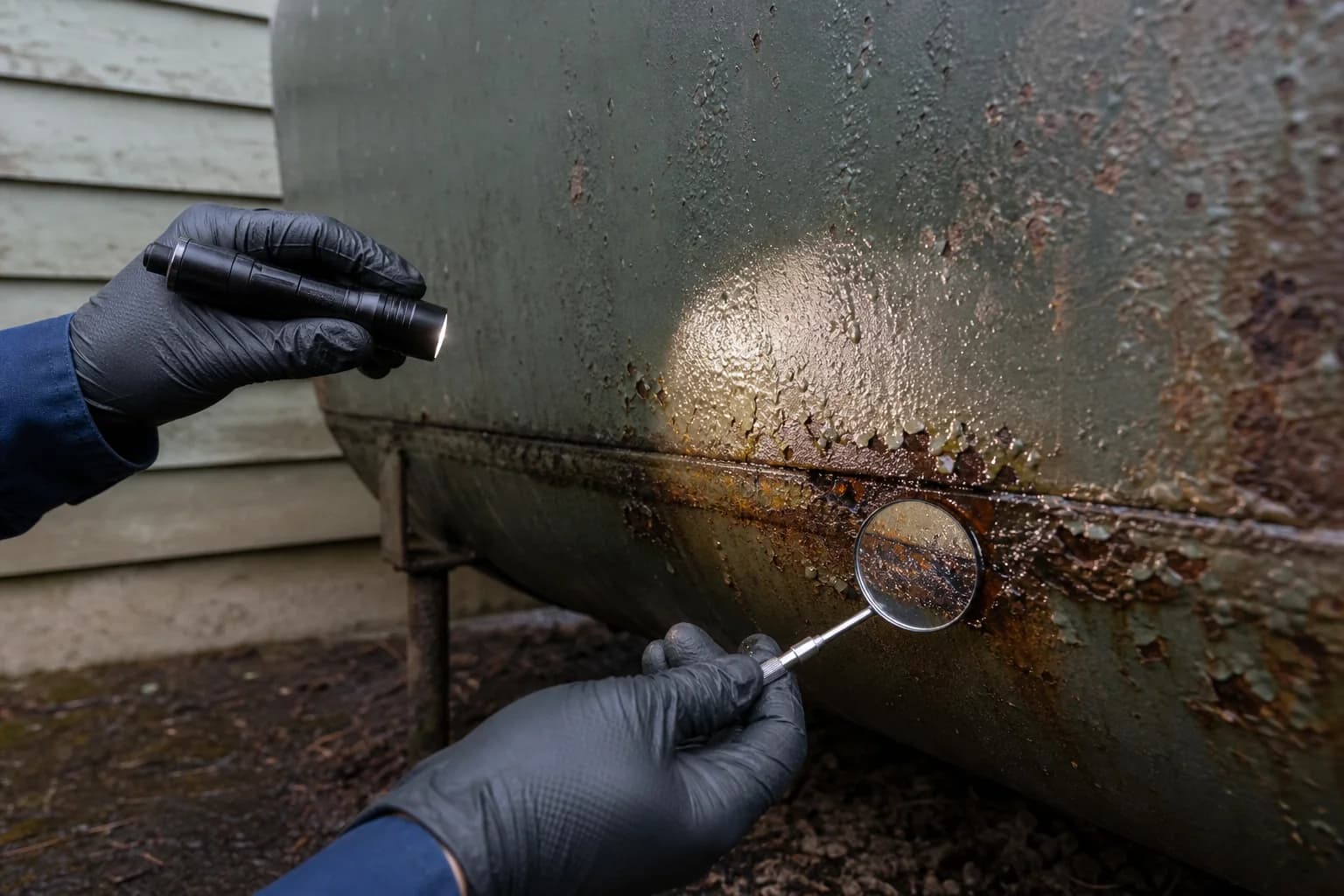
There is a difference between a tank that is actively leaking and a tank that is simply worn out and due for replacement before it fails. This page is about the second: reading the signs of age so you can act on your own schedule rather than in an emergency. If you suspect an active leak right now, go to the emergency response steps instead.
The replacement decision in Eugene is not a single path, which is the part most guides miss. Once a tank is out, you choose among a new tank, gas, or a heat pump. The replacement and conversion guide covers that three-way fork in full.
The signs a tank is due for replacement
These are about wear and risk over time, not a single failure. Any one is a reason to start planning; several together mean do not wait:
- 01.Age. Single-wall steel tanks installed from the 1940s through the 1980s, the common Eugene case, are well past their design life. Age alone is the biggest predictor.
- 02.Surface corrosion or weeping. On an aboveground or basement tank, visible rust, pitting, or a damp seam at the bottom is the metal telling you it is thinning.
- 03.Repeated repairs. A tank you have patched or had serviced more than once is on borrowed time; each fix addresses a symptom, not the age.
- 04.An insurer notice. Some Oregon insurers will not renew with an active heating oil tank, which is effectively a deadline to replace or convert.
- 05.Unreliable gauge or fill behavior. Readings that wander or fuel use that does not match the weather can signal the tank, not just the burner.
Why replacing ahead of failure is cheaper
The economics favor acting early, and by a wide margin. A planned replacement is a scheduled job at a known price. A failure is an emergency, and if it leaks it becomes a cleanup.
A worn tank that fails into the soil turns a routine decommissioning into a release case, with sampling, excavation, and a Cleanup Report, which adds months and, without prompt action, risk. Replacing on your timeline avoids that entirely. It also lets you compare your forward-heat options properly instead of grabbing the fastest fix in a cold snap.
Your three replacement directions in Eugene
When a Eugene tank comes out, the heat-source decision genuinely forks three ways, more than in a gas-default town:
- 01.A new oil tank. Cheapest upfront, keeps you on oil. Mostly chosen at the rural Lane County edge where gas is not available.
- 02.NW Natural gas. Mid-range, predictable, with modest conversion rebates. Common across the metro core.
- 03.An EWEB or SUB heat pump. Highest equipment cost before incentives, but Eugene's utility rebates plus the federal credit close much of the gap, and the running cost is usually lowest. A growing default here.
Tip
Reading the signs early buys you the time to compare all three properly. The old tank has to be decommissioned no matter which heat source you pick, so the smart sequence is to plan the replacement before the tank forces your hand. The replacement guide walks the full comparison.
Get a quote
Ready to schedule a Eugene-area decommissioning?
Free site survey, fixed-price written quote, full DEQ closeout documentation filed at the East 7th Avenue office. Most surveys scheduled within 48 hours.
Request a Written QuoteWhen to Act: Common Questions
How long does a heating oil tank last?+
Single-wall steel tanks, the common type around Eugene, were generally built for a few decades, and most still in service were installed between the 1940s and 1980s, so they are well past design life. There is no hard expiry date, but age is the strongest signal that replacement should be on your radar before failure.
Should I wait until my tank actually leaks to replace it?+
No. A planned replacement is a scheduled job at a known cost; a failure can become a leak, which turns a routine decommissioning into a months-long cleanup case. Acting on the warning signs, age, corrosion, repeated repairs, an insurer notice, is far cheaper than reacting to a release.
My insurer says they will not renew with an oil tank. What now?+
Treat it as a deadline to replace or convert. The tank has to be decommissioned regardless of what you choose next, so use the window to compare your three Eugene options, a new oil tank, NW Natural gas, or an EWEB or SUB heat pump, rather than defaulting to the fastest one.
Do I have to replace it with another oil tank?+
Not at all, and in Eugene many homeowners do not. Once the old tank is decommissioned you can switch to NW Natural gas or to a heat pump, and the local EWEB or Springfield Utility Board incentives plus the federal credit often make the heat pump the lowest ten-year cost. The replacement guide compares all three.
Related services and references
Guide
Eugene Oil Tank Replacement and Conversion
The three-way fork once the old tank is out.
Guide
Eugene Oil Tank Leak Emergency Steps
If the tank is already leaking rather than just worn.
Guide
Heating Oil to Heat Pump in Eugene
The electrification option and its incentives.
Guide
Complete Eugene Oil Tank Removal Guide
Decommissioning the old tank, whichever path you pick.
Service
Underground Oil Tank Removal
Retiring the failing tank.